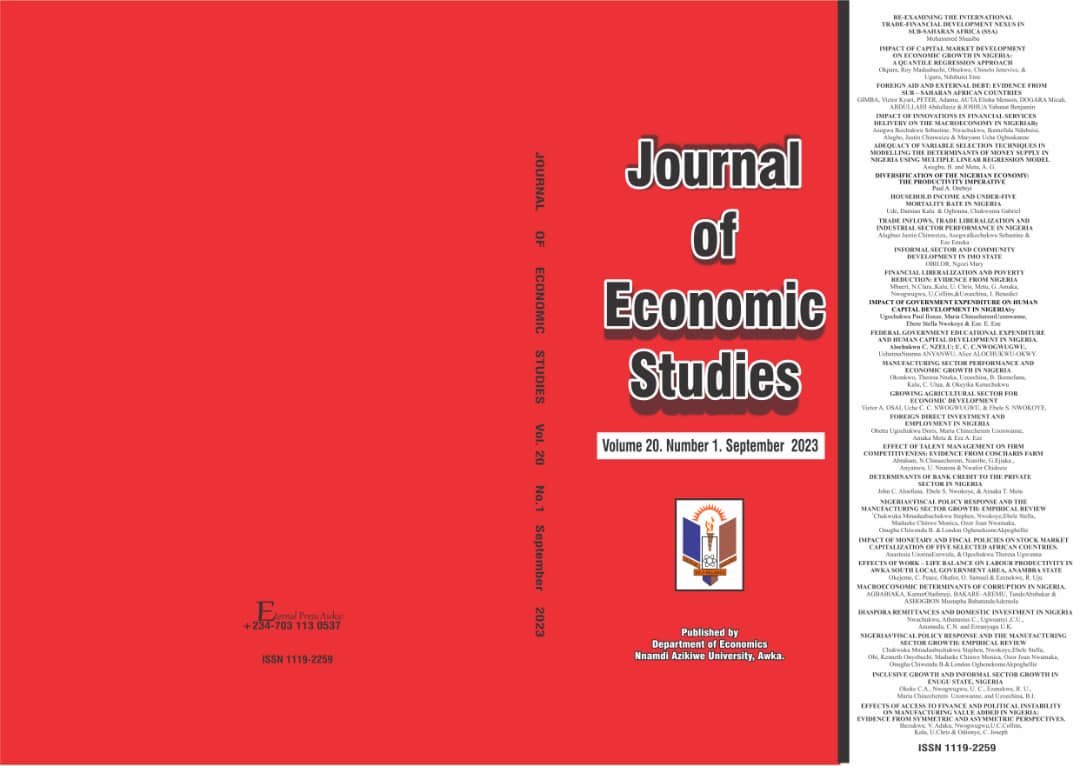
IMPACT OF GOVERNMENT EXPENDITURE ON HUMAN CAPITAL DEVELOPMENT IN NIGERIA
Keywords:
Human capital Development, Government expenditure on education, Government expenditure on health, Government expenditure on infrastructureAbstract
In Nigeria, human capital has been persistently weak, as evidenced by a Human Capital Index
(HCI) value of approximately 0.36, one of the lowest globally, reflecting chronic
underperformance in education, health, and workforce productivity outcomes. This study
examined the impact of government expenditure on human capital development in Nigeria over
the period 1990 to 2024. Annual time-series data were sourced from the Central Bank of Nigeria
(CBN), the National Bureau of Statistics (NBS), and the World Bank, and analysed using the
Autoregressive Distributed Lag (ARDL) bounds testing approach for integration. The long-run
estimates showed that government expenditure on education, government expenditure on health,
and gross fixed capital formation all exhibited positive relationships with the Human Capital
Index, suggesting that increases in sectoral spending contribute positively to human capital
development over time. In the short run, however, none of the expenditure variables exerted
statistically significant effects on human capital development, with the error correction term also
statistically insignificant, indicating weak adjustment from short-run disequilibrium to long-run
equilibrium within the study period. It therefore recommends that Nigeria reorient education
budgets toward direct service delivery inputs and strengthen primary healthcare systems through
adequate funding and monitoring of the Basic Health Care Provision Fund, to improve the
conversion of public spending into sustainable human capital outcomes.