Water Quality Assessment for Irrigation Purpose in Ikot Ekpene, Akwa Ibom State
Keywords:
Irrigation, Surface water, Water quality, Season, hydrogeochemical, River testingAbstract
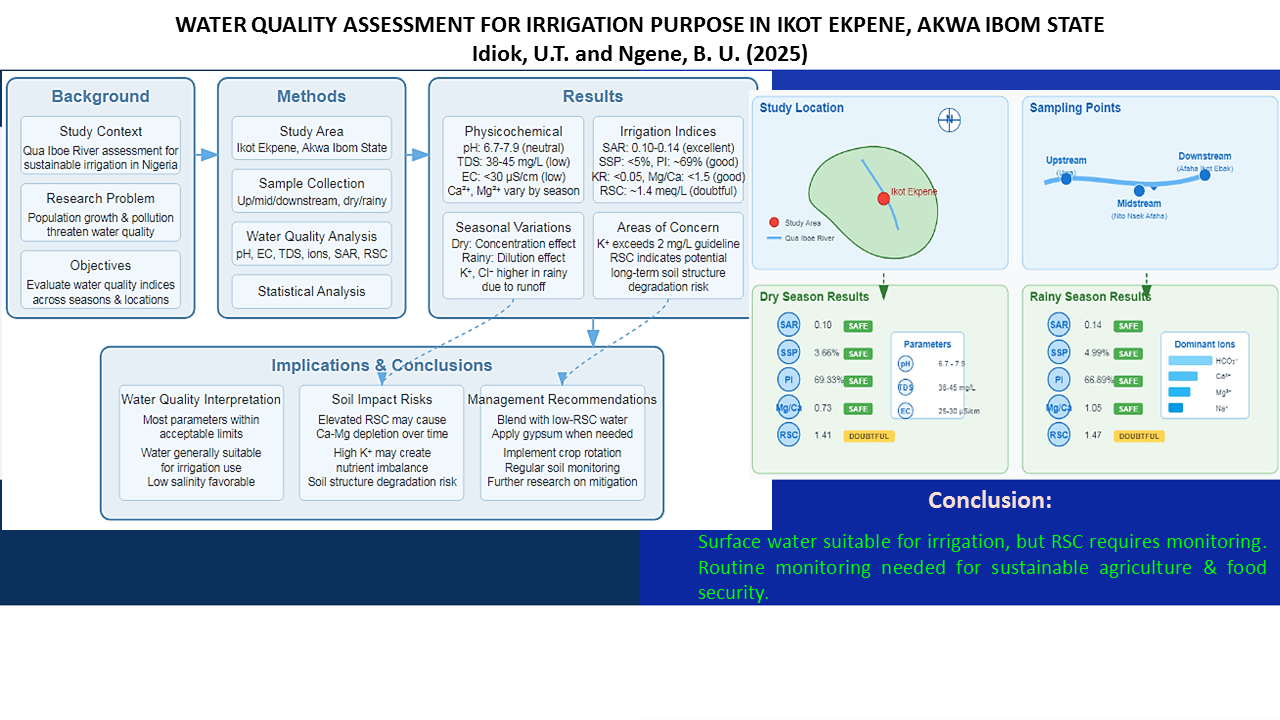
This study assessed Water Quality for Irrigation Purpose in Ikot Ekpene, Akwa Ibom State, Nigeria. Water samples were collected from upstream (Uwa), midstream (Nto Nsek Afaha), and downstream (Afaha Ikot Ebak) during both dry and rainy seasons. Important water quality indicators such as Sodium Adsorption Ratio (SAR), Residual Sodium Carbonate (RSC), Soluble Sodium Percentage (SSP), Permeability Index (PI), and the Magnesium to Calcium ratio (Mg/Ca) were analyzed. During the dry season, SAR was 0.10, SSP was 3.66%, PI was 69.33%, and Mg/Ca was 0.73. In the rainy season, SAR was 0.14, SSP was 4.99%, PI was 66.89%, and Mg/Ca was 1.05. These values fall within safe ranges for irrigation. However, RSC was 1.41 meq/L in the dry season and 1.47 meq/L in the rainy season, both classified as “doubtful,” indicating the need for caution with long-term use. Other results showed that pH ranged from 6.80 to 7.90 (dry) and 6.70 to 7.10 (rainy), TDS ranged from 38.33 to 44.67 mg/L (dry) and 39.68 to 40.20 mg/L (rainy), while EC ranged from 26.50 to 29.50 µS/cm (dry) and 25.11 to 26.32 µS/cm (rainy). The dominant ions were bicarbonate (HCO₃⁻), calcium (Ca²⁺), and sulfate (SO₄²⁻) with hydrogeochemical trend of HCO3− > Ca2+ > SO42− > Mg2+ > Cl− > K+ > Na+ (dry season), and HCO3− > SO42− > Ca2+ > Mg2+ > Cl− > K+ > Na+ (rainy season). Based on the forgoing, surface water from the Qua Iboe River in Ikot Ekpene, Akwa Ibom State can be used for irrigation to drive the agricultural productivity in the area. However, routine monitoring of both irrigation water quality and soil chemical properties is essential to prevent cumulative degradation and to ensure long-term agricultural sustainability. This study provides information into localized water quality, offering practical guidance for policymakers/farmers in smaller agrarian communities, contributing to the broader goal of food security. Future research should assess the long-term effects of using Qua Iboe River water with doubtful RSC on soil health and crop yield, and explore low-cost mitigation strategies.