Comparative analysis of dried dehulled and undehulled african breadfruit (treculia africana) seeds using oven drier
Keywords:
African breadfruit, moisture content, time, temperature, thermal propertiesAbstract
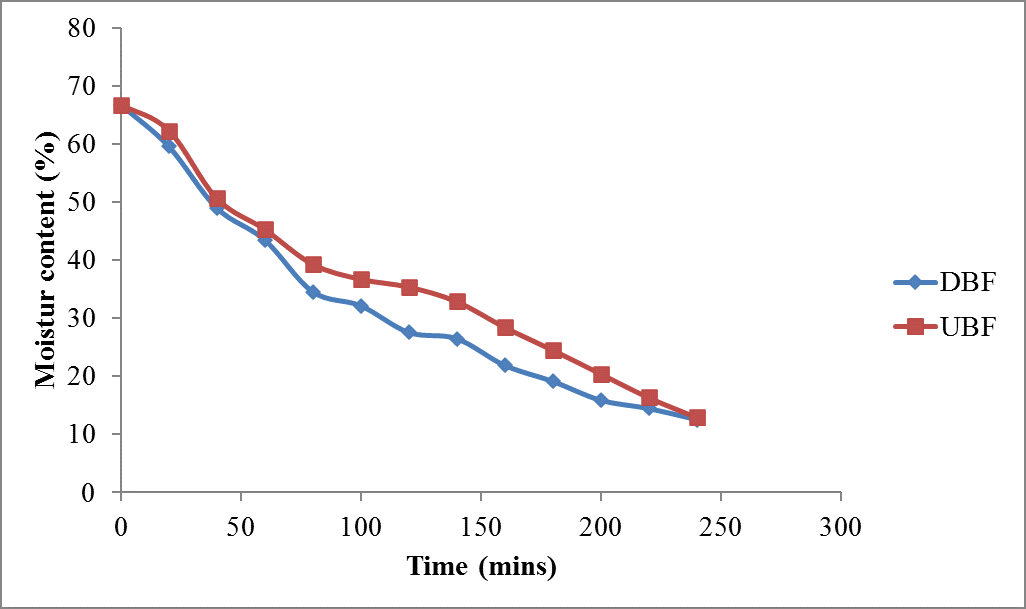
This study investigated the effect of process variables on the moisture content and thermal properties of oven-dried dehulled (DBF) and undehulled (UBF) African breadfruit seeds. Moisture content was determined using the gravimetric method, and the effects of drying time and temperature were assessed. At 70 °C, with an air speed of 2.5 m/s and 240 minutes of drying, moisture content decreased from 66.7% to 12.53% for DBF and 12.95% for UBF. At 40 °C, the moisture content reduced to 15.7% (DBF) and 24.03% (UBF), while at 70 °C, it further decreased to 0.75% and 2.7% respectively. Proximate analysis and thermal property measurements followed. After drying, the specific heat capacity decreased from 2.2405 kJ/kgK to 1.681 kJ/kgK (DBF) and 1.9108 kJ/kgK (UBF). Thermal conductivity dropped from 0.3047 W/mK to 0.226 W/mK for DBF and 0.27 W/mK for UBF. Thermal diffusivity increased from 2.21×10⁻⁴ m²/s to 2.23×10⁻⁴ m²/s (DBF) and 2.3×10⁻⁴ m²/s (UBF). The results showed that DBF experienced greater changes in moisture content and thermal properties than UBF, which may be attributed to the hull in UBF retaining moisture during drying. This indicated that dehulling enhanced moisture removal and altered the thermal properties more significantly during oven drying of African breadfruit seeds.