Assessing the Impact of Land Use Land Cover (LULC) and Climate Change on Groundwater Quality in Awka Agricultural Zone
Keywords:
Groundwater Quality, GIS, LULC, Climate, Awka Agricultural ZoneAbstract
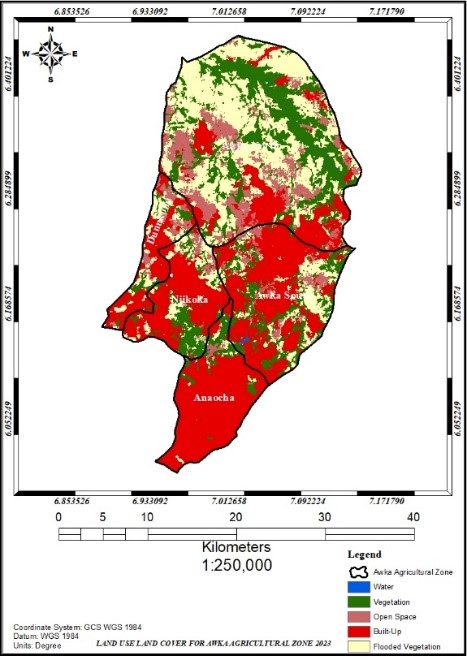
This study investigates the combined impacts of land use/land cover (LULC) changes, topographic variability, and climate-induced stressors on groundwater quality in the Awka Agricultural Zone, southeastern Nigeria. Over the past decades, rapid urbanization, agricultural intensification, and climate variability have increasingly degraded groundwater resources in sub-Saharan Africa. To address this, the study integrated physicochemical data, satellite-derived LULC classifications (2017, 2020, 2023 and 2024), and climate records of Awka Agricultural Zone from 2017 to 2024 within a GIS-based framework. Findings reveal that urban expansion and agricultural encroachment significantly reduce infiltration and elevate pollutant loads, while declining rainfall and rising temperatures intensify solute concentrations such as nitrates, TDS, and heavy metals. Statistical analyses show strong correlations between groundwater parameters and environmental variables, confirming the interactive nature of anthropogenic and climatic pressures. This research offers a spatial-temporal approach for identifying contamination hotspots and recharge-limiting zones, providing critical insights for adaptive groundwater governance, spatial planning, and climate resilience in data-scarce agro-ecological regions.