Bio-accumulation and dose-response modeling of heavy metals in human tissues
Keywords:
Bioaccumulation, Dose-response, Heavy metals, Breast cancer, ODE modelling, MATLABAbstract
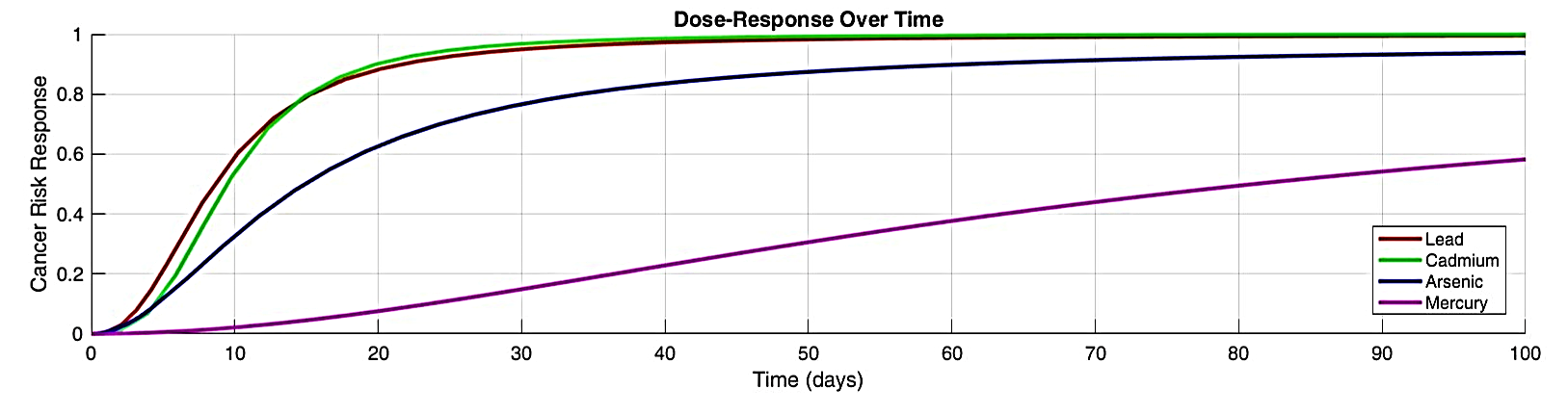
Several cases of cancer have been connected to exposure to heavy metals as a result of bioaccumulation of these metals and their toxic effects. Understanding how these metals accumulate in tissues and the resultant biological reactions is of great importance for public health policymakers and the development of preventive measures. This study models the bioaccumulation and dose-response behaviour of four carcinogenic metals, lead (Pb), cadmium (Cd), arsenic (As), and mercury (Hg) in malignant human tissue, using ordinary differential equations (ODEs) in MATLAB. This simulation examines their concentration dynamic over time and their respective carcinogenic risk profiles. Using a first-order ODE model, the bioaccumulation in human tissue was simulated for exposure over 100 days. The uptake of heavy metals and their elimination rate constants were collected from peer-reviewed literature. A Hill-type dose-response model was used, and MATLAB's ode45 solver was used for the numerical integration. Accumulation of cadmium (cd) and lead (Pb) was the highest in the tissue, and both metals were also the highest to be associated to cancer risk, which reached over 70% bio-response during the simulation window. Arsenic (As) and mercury (Hg) showed the slowest bio-accumulation rate as well as dose-response levels. Due to high bio-accumulation and steep dose-response slope of Cadmium, its risk is amplified. Cadmium and lead pose a greater risk to human tissue health under severe exposure. The findings from this study contributes to environmental health policies and cancer prevention remedies among people who are exposed to heavy metals.