Advanced Techniques for Fuel Blend Optimization Using Machine Learning, Thermodynamic Modeling and Experimental Validation Methods
Keywords:
Advanced techniques, Fuel Blend Optimization, Machine Learning, Thermodynamic Modeling and Experimental Validation Methods.Abstract
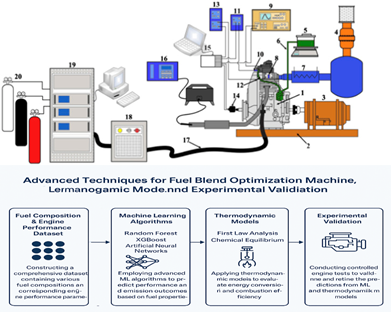
The growing demand for cleaner and more efficient energy sources in internal combustion engines necessitates the development of optimized fuel blends. Conventional diesel, despite its high energy density, suffers from suboptimal combustion efficiency and elevated pollutant emissions. This study, titled Advanced Techniques for Fuel Blend Optimization (FBO) Using Machine Learning (ML) Thermodynamic Modeling (TDM) and Experimental Validation Methods (EVMs), aims to enhance engine performance and reduce emissions through the integration of alternative fuel blends (AFBs) and advanced predictive techniques. The primary objective is to identify optimal fuel formulations that outperform conventional diesel in thermal efficiency and environmental impact while leveraging modern machine learning (ML) and thermodynamic tools for performance forecasting and analysis. The methodology involves experimental testing of multiple diesel-diethyl ether (DEE) fuel blends, thermodynamic assessments including exergy and entropy analyses, and the application of three ML models Random Forest (RF), Extreme Gradient Boosting (XGBoost) and Artificial Neural Networks (ANN) to predict engine parameters such as Brake Thermal Efficiency (BTE), NOₓ and CO emissions. Results show that Blend B4 (70% diesel + 30% DEE) achieved the highest BTE (34.0%), lowest BSFC (230 g/kWh), and significantly reduced emissions. XGBoost outperformed other ML models with R² values above 0.90 and lowest prediction errors (MAPE < 3%). The study concludes that oxygenated, high-cetane blends like B4 offer superior performance and environmental benefits. Furthermore, ML-based predictive models, particularly XGBoost, are reliable tools for real-time engine optimization. It is recommended that future research explore broader fuel types and integrate ML with real-time control systems for smart combustion management