Carbonate Facies and Depositional Environment of the Kalambaina Formation, Sokoto Basin, Northwestern Nigeria
Keywords:
Kalambaina Formation, microfacies, wackestone, limestone, transgressive system tractAbstract
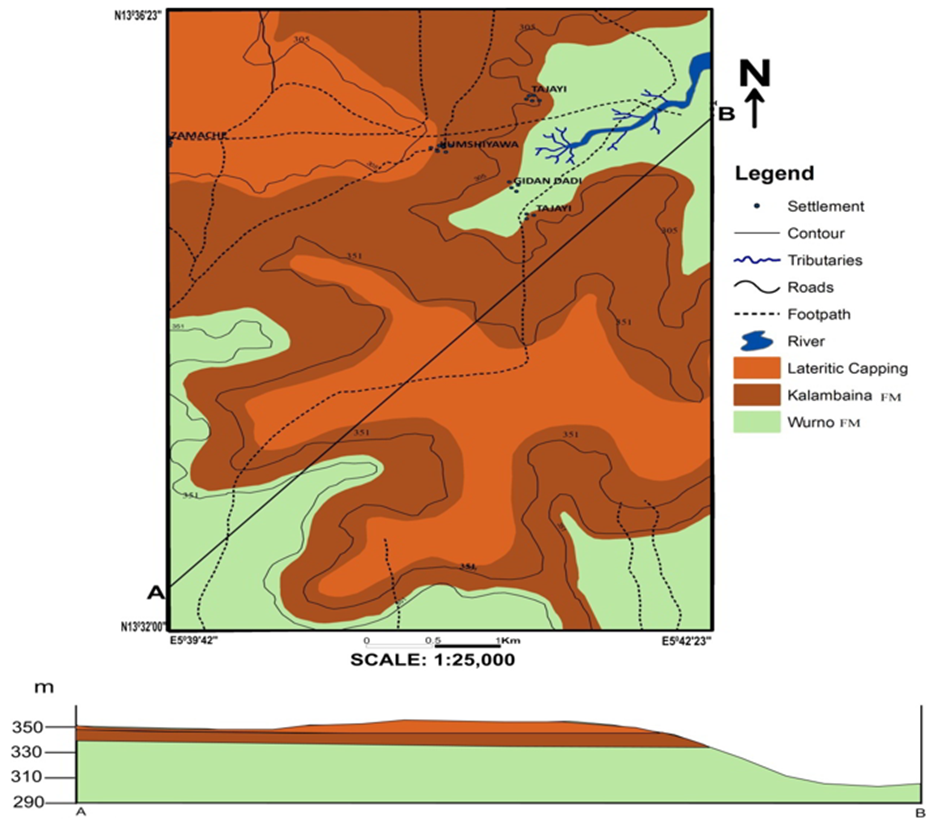
The Kalambaina Formation, part of the Paleocene Sokoto Group in the Iullemmeden Basin, represents a critical stratigraphic unit for understanding shallow marine sedimentation in northwest Nigeria. This study aims to characterize the lithologic, stratigraphic, and petrographic features of the formation to infer its depositional environment and economic significance. Field investigations were conducted across four key localities to document lithologic successions, while thin-section petrography was performed to identify microfacies and matrix composition. Results reveal a consistent vertical sequence of phosphatic shale overlain by fossiliferous limestone at all localities, suggesting a marine transgressive system. At Locality 1, the basal phosphatic shale transitions sharply into a 1.2m fossiliferous limestone, indicating a rapid environmental shift. Locality 2 shows a gradational boundary between a 3.5m shale unit and a 3m limestone, indicative of continuous transgression. Thin-section analysis classifies the limestone as biomicrite and wackestone adapting Folk and Dunham’s classifications respectively. Micrite are micro crystalline carbonate having major or only rock component while wackestone are depositional textures that contains carbonate mud of greater than 10% grains. Fossil assemblages, including Elphidium Crispum and Endothyra, confirm deposition in low-energy intertidal to subtidal zones. The findings suggest that the Kalambaina Formation was deposited in a shallow marine carbonate platform influenced by periodic transgressive-regressive cycles. The phosphatic shales, with potential as hydrocarbon source rocks, and the porous fossiliferous limestones, indicative of reservoir potential, highlight the formation’s economic importance. Comparisons with analogous systems in the Tarim Basin and Zagros Foreland Basin reinforce its role in regional sedimentary processes. This study provides new insights into the stratigraphic and paleoenvironmental evolution of the Kalambaina Formation, offering a framework for future hydrocarbon exploration and geological research in the Iullemmeden Basin.