Enhancing Hydrocarbon prospect delineation through cross-plots and rock physics model: a case study of the NKO field onshore Niger Delta Basin, Nigeria
Keywords:
Hydrocarbon prospect, delineation cross-plots, rock physics, NKO field onshore, Niger Delta BasinAbstract
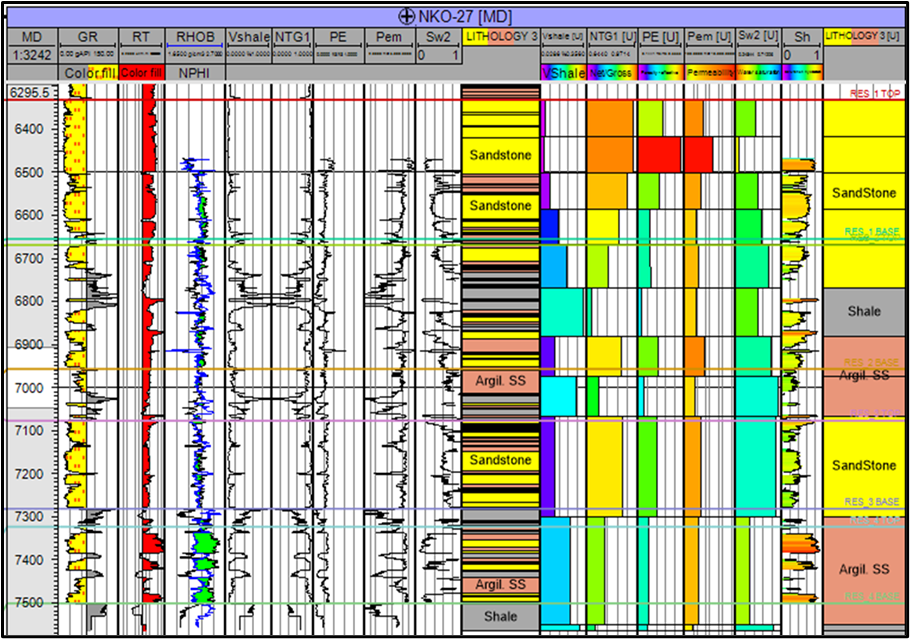
The NKO Field, located in the Central Swamp Depobelt of the Niger Delta Basin, Nigeria, is a structurally complex hydrocarbon-bearing system. This study integrates cross-plot analysis and rock physics modeling to enhance reservoir characterization and hydrocarbon prospect delineation. Well log and seismic data from 32 wells were used to delineate lithofacies, evaluate petrophysical properties, and characterize reservoirs. Results show the reservoirs thin northeastward, with cross-plot analysis effectively distinguishing four fluid/lithology zones: gas, oil, brine, and shale. Rock physics modeling indicates that plastic deformation predominates, causing compaction, reduced porosity and permeability, and impacting hydrocarbon productivity. A petro-elastic model was developed to differentiate reservoir rocks from non-reservoirs, providing insights into elastic and lithological properties. Upscaling of porosity, permeability, net-to-gross, water and hydrocarbon saturation, and facies successfully captured heterogeneity, faults, fractures, and multiphase flow behavior in the reservoirs. A 3D grid-based geological model estimated hydrocarbon volumes: Stock Tank Oil Initially in Place (STOIIP) of ~102.9 million stock tank barrels with a 35% recovery factor, and Stock Tank Gas Initially in Place (STGIIP) of ~1.11 billion stock tank barrels with a 100% recovery factor. These findings demonstrate that integrating cross-plot analysis with rock physics models enhances reservoir evaluation, supports accurate identification of hydrocarbons, and informs optimal field development strategies