CFD-Informed Machine Learning Prediction of Internal Corrosion Rates in Buried Gas Pipelines Under Turbulent Flow Conditions
Keywords:
Internal Corrosion, Artificial Neural Network, Computational Fluid Dynamics, Machine Learning, XGBoost, Turbulent FlowAbstract
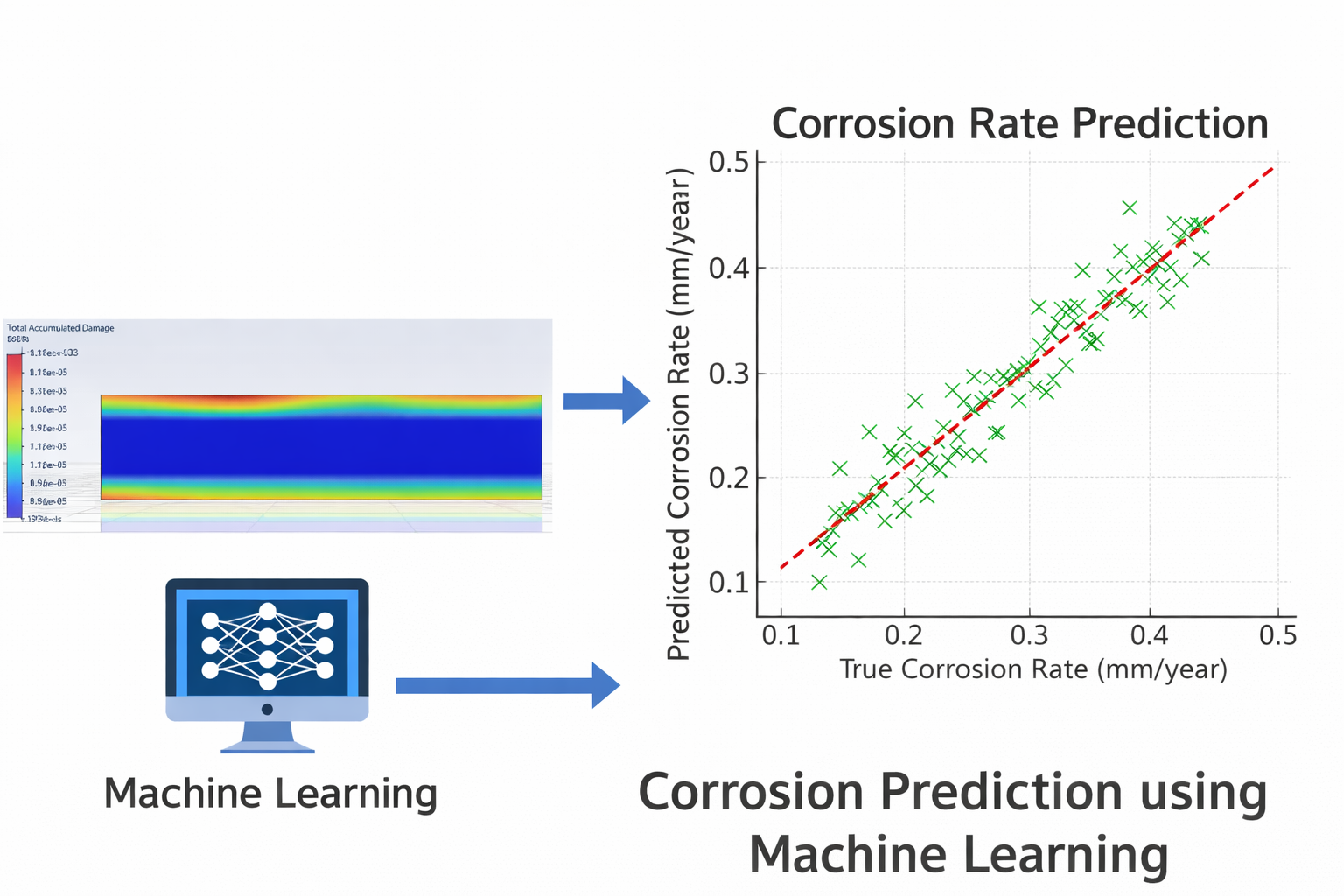
Internal corrosion remains a critical integrity challenge in gas transmission pipelines, particularly under turbulent flow conditions where complex fluid–structure interactions accelerate material degradation. This study presents a CFD-informed machine learning framework for predicting internal corrosion growth rates in a buried, unprotected gas pipeline, using a representative segment of the Ajaokuta–Kaduna–Kano (AKK) pipeline system in Nigeria as a case study. Computational Fluid Dynamics simulations were performed using ANSYS Fluent to characterize key flow-induced parameters, including velocity, pressure, temperature, wall shear stress, and turbulence intensity under turbulent operating conditions. These CFD-derived features were subsequently employed as inputs to supervised machine learning models—Artificial Neural Network, Support Vector Machine, Random Forest, eXtreme Gradient Boosting, and linear regression, to predict internal corrosion rates. Model performance was evaluated using standard statistical metrics, including the coefficient of determination (R²), mean absolute error, and root mean square error. Among the evaluated models, the XGBoost algorithm demonstrated the best predictive performance, achieving an R² value of 0.95 with low prediction error. Feature-importance analysis revealed turbulence intensity and flow velocity as the most influential parameters governing internal corrosion development, consistent with established corrosion and flow-accelerated degradation mechanisms. While the high prediction accuracy reflects the effectiveness of combining CFD-derived features with data-driven learning, the study acknowledges the limitations associated with simulated datasets and the absence of detailed corrosion chemistry and inhibitor effects. The proposed framework offers a practical, data-driven tool for corrosion risk assessment and predictive maintenance planning in Nigerian gas pipeline infrastructure. It provides a foundation for future integration with field inspection data and experimental validation to support real-time pipeline integrity management.