Investigating the improvement of spectral efficiency of massive MIMO systems in Rayleigh fading channels and LOS propagation channels
Keywords:
Heterogeneous Network, Line of Sight Propagation, Massive MIMO, MMSE, MRT, Rayleigh Fading Channels, Spectral EfficiencyAbstract
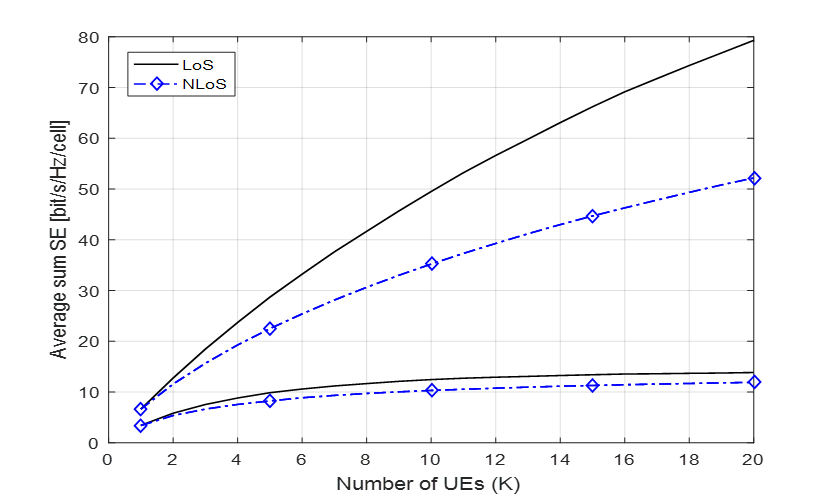
Over the last decade, multiple-input multiple-output (MIMO) systems have substantially enhanced the spectral efficiency (SE) of cellular networks, and in recent years, Massive MIMO (mMIMO) technology has leverage on that to provide more significant improvement of SE in 5G network. However, most of these improvement have been recorded over flat fading channels and frequency selective fading. This work deviated from the norm by investigating the level of improvement of SE of mMIMO systems in Rayleigh fading channels and line of sight (LoS) propagation channels. To achieve this, conceptualized system models were devised for an uplink massive MIMO systems comprising of a two-tier heterogeneous network (HetNet) and a downlink massive MIMO system comprising of a two-tier HetNet from where mathematical models were developed. The systems were evaluated using user-specific performance indicators, such as the signal-to-noise ratio (SNR), along with system-level utility measures, including the average spectral efficiency. The results show that increasing the base station antenna count improves the spectral efficiency of the system which can grow remarkably as the base station antenna count approaches infinity. Moreover, deploying more base station antennas than the number of active UEs in a cell can enhance the downlink average spectral efficiency, facilitated by precoding schemes like Maximum Ratio Transmission (MRT) and Minimum Mean Square Error (MMSE). This finding is same for both Rayleigh (NLoS) fading channels and LoS propagation channels.