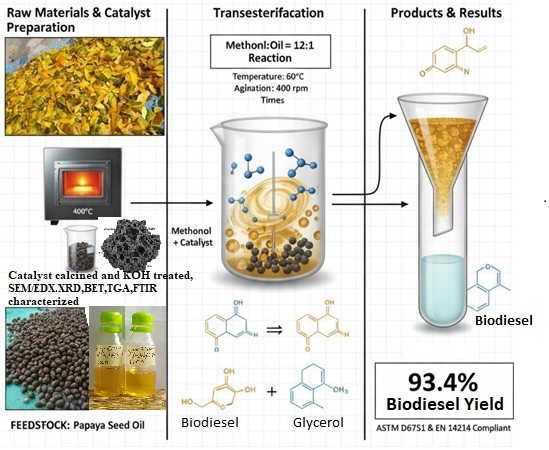
Valorization of Papaya Peel Waste via Calcination and KOH Activation into a High-Performance Heterogeneous Catalyst for Biodiesel Production
Keywords:
Papaya peels, Heterogeneous catalyst, Biodiesel, Calcination, Potassium HydroxideAbstract
The rising need of the sustainable energy emphasizes biodiesel as a possible alternative to petro-diesel. The proposed study is an implementation of a zero-waste approach by transforming the waste of papaya peel into an effective heterogeneous solid base catalyst to transesterify papaya seed oil. Calcination was used to make the catalyst and activated with KOH. SEM/EDX, XRD, BET, FTIR and TGA measurements of the fibrous biomass proved the successful transformation of the fibrous biomass to a microporous catalyst with a BET surface area of 150.5m2/g, a high thermal stability and rich CaO active sites. The elemental analysis showed that the quantity of carbon decreased by 75.7%, calcium increased by 166.5%, and the basicity enhancer, potassium, was successful. An optimum yield of 93.43% biodiesel was obtained under the following conditions; 12:1 methanol to oil ratio, catalyst loading of 1.0 wt%, reaction time of 2.0 hours, agitation of 400, and temperature of 60oC. The biodiesel complied with ASTM D6751 and EN 14214 requirements on specific gravity (0.8684), cetane index (57.371), and flash point (157oC), but, with a kinematic viscosity (6.843mm2/s), was marginally higer but can be corrected by blending. This shows proper waste valorization to a cost effective production of biodiesel.