Design and Implementation of a Noise Pollution Monitoring and Alert System
Keywords:
Noise pollution, Microcontroller, Microphone, Decibel, MultiplexerAbstract
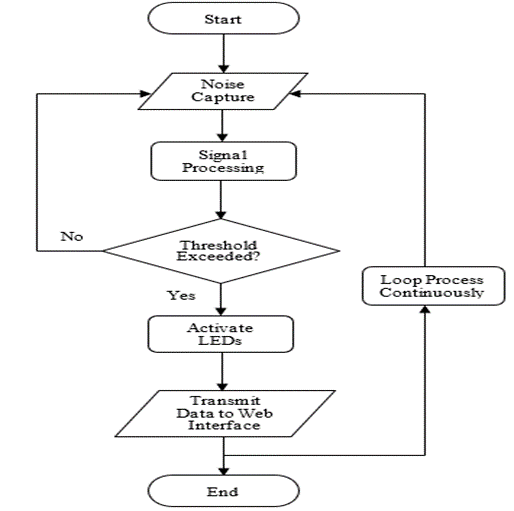
This research effort addresses the challenges caused by uncontrolled noise which can impair academic integrity and cause students to lose focus. Then, design and implementation of a noise pollution monitoring and alert system specifically designed for academic settings is provided. The solution involves three omnidirectional microphones connected through a multiplexer to an ESP32 microcontroller. Real-time sound input is mapped to approximate decibel levels by a threshold-based logic system that is built with the Arduino IDE which triggers a tri-colour LED alert mechanism for disturbances. The noise level is observed from several input locations using a web interface built on Flask, which offers real-time monitoring capabilities. The results show that the microcontroller started the proper alert logic after processing the readings in an average time of 0.34 seconds, the constructed device exhibits a quick response time of 0.7 seconds and dependable performance for two and a half hours. It functions well without constant internet connectivity, which is a significant improvement over the existing designs. The modular architecture guarantees scalability to other domains like offices and libraries. The system would improve examination invigilation and adherence to recommended acoustic standards.