Eco-Friendly Corrosion Inhibition of Mild Steel Using Biomass-Derived Carbon Quantum Dots from Banana Peels: A Sustainable Approach
Keywords:
Corrosion inhibition; carbon dots; Banana peels carbon dots (BP-CDs); weight loss, electrochemicalAbstract
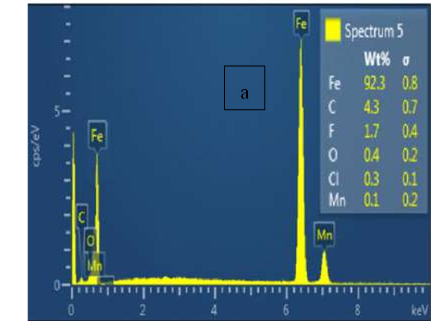
In this study, the banana peels carbon dots (BP-CDs) was synthesized by hydrothermal method. The BP-CDs was characterized using ultraviolet - Visible spectrophotometer (UV - Vis) and Transmission Electron Microscopy (TEM). The potential of the BPCDs to prevent mild steel from corroding in 1 M HCl was investigated using weight loss, electrochemical impedance spectroscopy (EIS), and potentiodynamic polarization (PDP) techniques. The effects of concentrations of the BP-CDs, immersion times and temperature against corrosion of mild steel in 1 M HCl were investigated. The inhibition efficiency (IE) of the BP-CDs generally increased with concentration. Result from weight loss technique test at 30°C, shows that corrosion inhibition efficiency (IE) of the optimum concentration investigated increased with an increase in immersion time up to 75.9 % at 72 h but decreased thereafter to about 63.7 % at 144 h. The weight loss test results further revealed that the inhibition efficiency increased with increase in temperature of the medium reaching a value of 90.2 % at 60oC. The high values of IE for the carbon dot at 60°C was indicative of chemisorption mode of adsorption of the carbon dots on mild steel surfaces. The PDP analysis showed that the BP-CDs acted as mixed - type corrosion inhibitor. The surface characterization of the steel samples submerged in the blank 1 M HCl and in the1 M HCl with carbon dots using Scanning Electron Microscope (SEM), Energy Dispersive X - ray Spectroscopy (EDS), 3D Profilometer images as well as Atomic Force Microscope (AFM) showed decreased surface roughness of mild steel surfaces on addition of the inhibitors, an indication of decrease in corrosion attack by HCl due to the formation of passivation layer on the steel surfaces.