Development of a Universal Performance Correlation for Low-Cost Ceramic Membranes in Wastewater Microfiltration Using Buckingham Pi Theorem
Keywords:
Ceramic membrane, Buckingham Pi Theorem, Microfiltration, Wastewater treatment, Heavy metals, Azo dyes, Dimensional analysis, Lead, Cadmium, Disperse Yellow 7, Trypan BlueAbstract
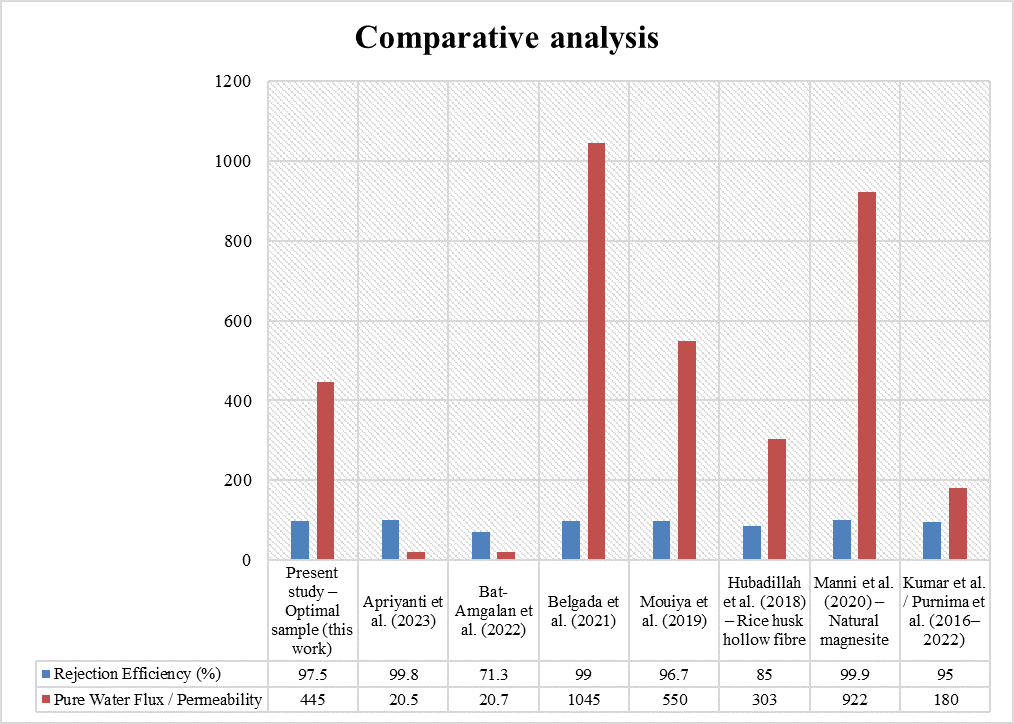
The high cost of conventional ceramic membranes limits their widespread adoption in wastewater treatment, despite their excellent performance. While low-cost alternatives derived from natural and waste materials have been explored, existing performance correlations remain empirical and scale-dependent, hindering reliable scale-up. This study addresses this gap by applying the Buckingham Pi Theorem to develop the first universal, scale-independent performance correlation for ceramic microfiltration membranes fabricated from indigenous Nigerian materials (clay, kaolin, rice husk ash, sawdust, and snail shell). The membranes were designed using Response Surface Methodology (Central Composite Design) and evaluated for the removal of Pb²⁺, Cd²⁺, Disperse Yellow 7, and Trypan Blue from synthetic wastewater. Dimensional analysis transformed critical performance data into novel dimensionless groups, generating predictive master curves for permeate flux, pore size, porosity, and flexural strength. The derived correlations demonstrated excellent predictive power, with R² values ranging from 0.85 to 0.96. An optimized membrane formulation achieved a pure water flux of 445 L/m²·h, a flexural strength of 32.1 MPa, a porosity of 49.8%, and a pollutant rejection rate exceeding 97%. This work demonstrates that low-cost, locally sourced precursors can yield high-performance membranes without compromising efficiency. The established dimensionless correlations offer a rigorous and generalizable tool for the rational design and scale-up of sustainable ceramic membrane systems in resource-limited settings.