Finite element modelling and prediction of cutting temperature in carbide insert cutting tool
Keywords:
Carbide insert cutting tool, modeling, prediction, Finite Element Method (FEM)Abstract
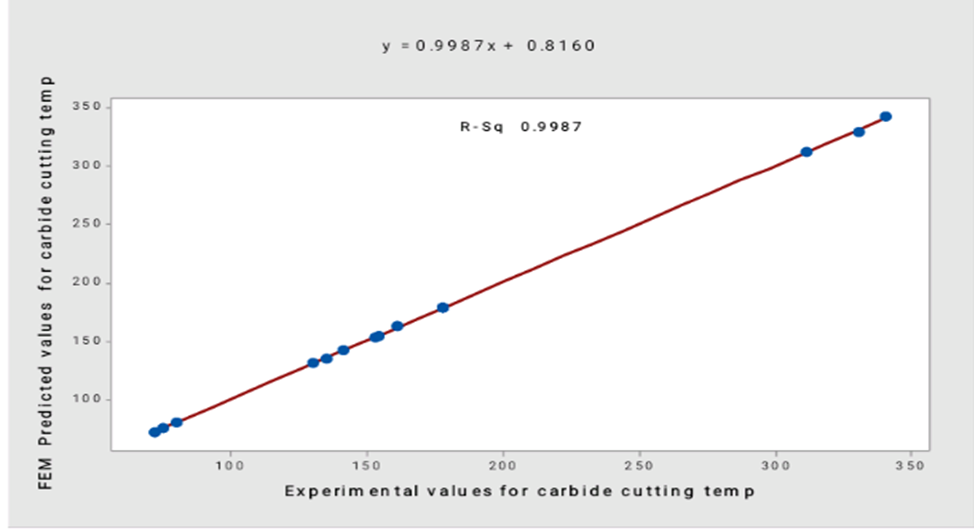
The finite element modeling and prediction of cutting temperature in carbide insert cutting tool was investigated in this study under varying process parameters of 200-600rpm spindle speed, 0.05-0.15mm/rev feed rate and 0.5-1.5mm depth of cut. The aim of the study is to show how efficient Finite Element method is in predicting the cutting temperature of carbide cutting tool, by comparing its predictive strength to the experimental machining operation. To achieve the aim of the study, seventeen varying cutting tool tests were conducted using the three levels Box-Behnken’s design (BBD) of experiment. Combing both methods enhances the accuracy of the prediction efficiency compared to the single method techniques. FEM predicted cutting temperature were found to be 72.10 oC and 72.66oC respectively at 200rpm spindle speed, 0.1mm/rev feed rate and 0.5mm depth of cut. The model had a mean percentage error of 0.58% and a R2 value of 0.9987. Validation of the model using reliability plot indicated no significant difference between the experimental observations and the model prediction.