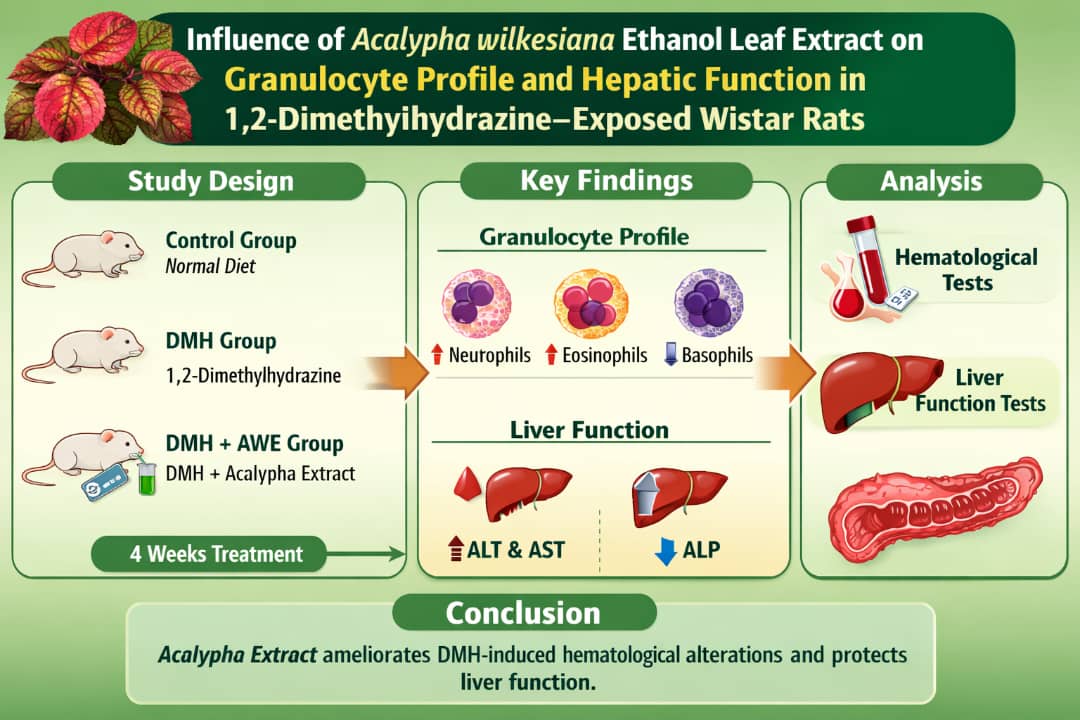
Influence of Acalypha wilkesiana Ethanol Leaf Extract on Granulocyte Profile and Hepatic Function in 1,2-Dimethylhydrazine–Exposed Wistar Rats
Keywords:
Acalypha wilkesiana, 1,2-Dimethylhydrazine, Hepatotoxicity, Granulocytes, Liver enzymesAbstract
Acalypha wilkesiana is a herbaceous plant widely used in ethnomedicine for the management of inflammatory and metabolic disorders. This study investigated the influence of A. wilkesiana ethanol leaf extract on granulocyte profile and liver function indices in Wistar rats exposed to 1,2-dimethylhydrazine (DMH). Thirty male Wistar rats randomly selected were assigned into six groups: control, DMH control, DMH + Xeloda, and DMH treated with 200, 400, and 800 mg/kg body weight of the extract. DMH was administered subcutaneously for six weeks, followed by treatment for fourteen days. Granulocyte counts, liver enzyme [serum alanine aminotransferase (ALT), aspartate aminotransferase (AST)] activities and liver histology were evaluated. DMH exposure resulted in significant elevation of ALT and AST activities (p < 0.05) and severe hepatic histopathological alterations. Treatment with Xeloda and A. wilkesiana extract significantly reduced ALT and AST levels and improved liver architecture. Neutrophil and basophil counts were not significantly altered across groups, while eosinophil count increased significantly at the highest extract dose. The findings demonstrate that A. wilkesiana ethanol leaf extract confers dose-dependent hepatoprotection against DMH-induced toxicity with minimal disruption of granulocyte homeostasis at low and medium doses. The study supports the applied potential of A. wilkesiana as a hepatoprotective agent, with dose regulation being critical.