Quadratic Drag–Based Modeling and Experimental Validation of Palm Nut Cracking and Separation Trajectories
Keywords:
Quadratic projectile drag principle; Palm nut cracking and separation; Aerodynamic interactionAbstract
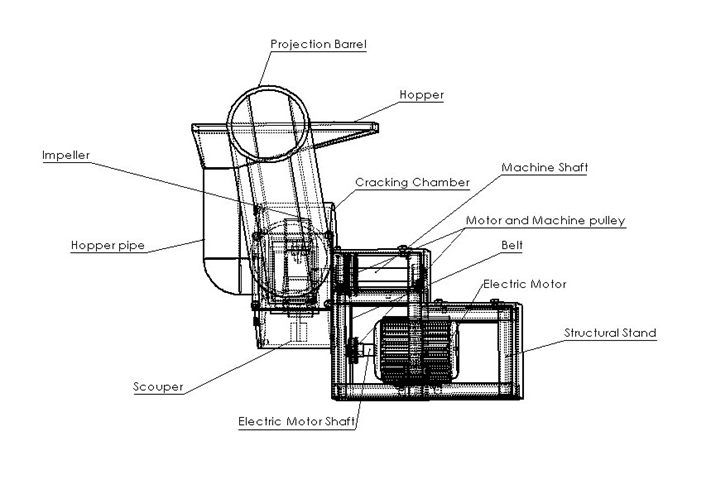
Efficient separation of palm kernels from the shells remains a critical challenge in palm kernel oil processing, with conventional methods typically achieving inadequate separation efficiency. Traditional method which has high separation efficiency is however slow and labour-intensive. This study developed and experimentally validated a quadratic drag–based projectile motion model that predicted and optimized the post-cracking separation trajectories of palm nuts components in centrifugal cracking systems. The model incorporated particle-specific mass, geometry, drag coefficients, and air resistance effects, and was numerically solved for projection angles ranging from 10° to 45° and discharge velocities of 10 m/s and 15 m/s. Experimental trials were conducted using a fabricated centrifugal cracking and separation machine to validate the model predictions. Results show that separation effectiveness increases with both projection angle and velocity due to enhanced aerodynamic drag interaction. At 10 m/s, optimal separation was achieved between 30° and 40°, while at 15 m/s, a projection angle of 30° produced the clearest spatial separation with minimal space requirement. Under this optimal condition, kernel, nut, and shell deposition distances were 18.75 m, 17.44 m, and 13.72 m, respectively. Polynomial fits of displacement versus angle yielded excellent agreement with experimental data, with coefficients of determination (R² ≥ 0.995). The study demonstrates that quadratic drag effects are essential for accurately predicting separation trajectories at practical operating speeds. The proposed model provides a physics-based separation principle (an alternative engineering approach to age-old processing steps), predictive framework for optimizing separator design and operating parameters (formulation of empirical models, for the first time, that could enable prediction of separation distances before the actual design application), thereby reducing reliance on empirical trial-and-error approaches in palm kernel processing systems.