Effect of sawdust–rice husk blend ratios and adhesive type on particleboard properties
Keywords:
Particleboard; Rice husk; Sawdust; Urea-formaldehyde; Phenol-formaldehyde; Cassava starch; Strength Properties; Physical PropertiesAbstract
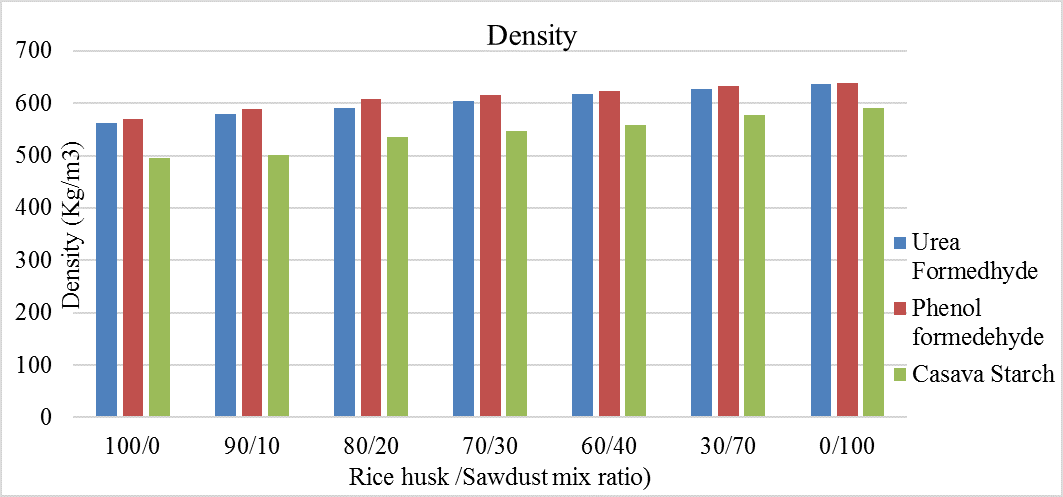
The rising need for cheaper and more sustainable Building materials has generated interest in converting wood-processing and agricultural waste into Building Material. This study investigates the feasibility of producing particleboard from sawdust and rice husk, concentrating on the impact of adhesive type and mix ratio on board performance. Twenty-seven particleboard samples were made using seven sawdust–rice husk ratios (90:10, 80:20, 70:30, 60:40, 30:70, 0:100, and 100:0) and three binders (phenol-formaldehyde, urea-formaldehyde, and cassava starch). Key Structural and physical properties of the boards were evaluated, including density, moisture content, water absorption, thickness swelling, impact strength, compressive strength, and modulus of rupture (MOR). Results indicated that densities ranged between 495 and 639 kg/m³ and moisture contents ranged from 7.17% to 11.95%. Water absorption and thickness swelling varied from 30.25–37.47% and 9.01–15.15%, respectively. Compressive strength ranged from 0.11 to 0.492 N/mm², impact strength from 2.22 to 4.80 kg/m³, and MOR from 9.87 to 17.92 N/mm². Boards bonded with phenol-formaldehyde consistently exhibited superior mechanical strength and dimensional stability, followed by urea-formaldehyde and cassava starch. Increasing sawdust content enhanced density and mechanical performance, with the 30:70 rice husk–sawdust ratio yielding optimal overall properties. These results support the development of resource-efficient building materials and shows that sawdust-rice husk particleboards are viable, feasible and sustainable substitutes for traditional wood-based panels.