An Experimental Analysis of Embedding Separability and SVM Classification in Hybrid Face Recognition Systems
Keywords:
Experimental Analysis, Separability, SVM Classification, Hybrid Face Recognition Systems, embeddingAbstract
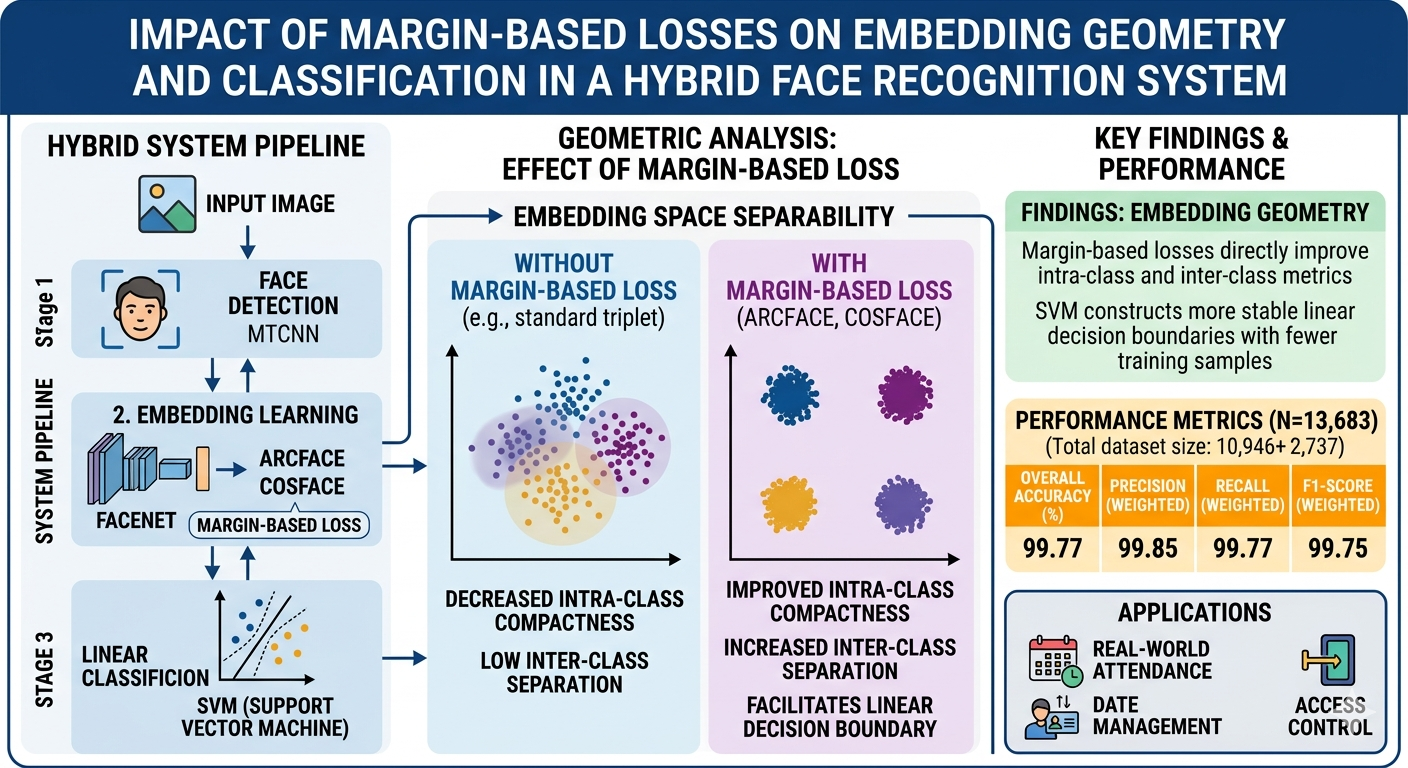
This paper presents an experimental analysis of embedding separability and classification performance in a hybrid face recognition system combining Multitask Cascaded Convolutional Neural Network-based face detection, FaceNet-based embedding learning, and Support Vector Machine (SVM) classification. The study focuses on the effect of margin-based loss functions on the geometric structure of learned face embeddings and their influence on downstream recognition accuracy. ArcFace- and CosFace-trained embeddings are evaluated using classification metrics and cosine-distance–based separability analysis. Experimental results show that margin-based losses significantly improve intra-class compactness and inter-class separation, enabling the SVM to construct stable linear decision boundaries with improved generalization under limited training samples. The hybrid framework achieves competitive recognition performance with lower inference complexity compared to end-to-end deep classifiers. With a dataset that has 10,946 training samples and 2,737 testing samples, the framework had an Overall accuracy (%) of 99.77%, Precision (weighted) of 99.85%, Recall (weighted) of 99.77% and F1-score (weighted) of 99.75%. These findings highlight the importance of embedding geometry in hybrid face recognition systems and support their suitability for real-world attendance management and access control applications.