Influence of Mineralogical and Chemical Composition on the geotechnical index properties and compaction characteristics of Borrow Pit Soils and Onitsha River Sand, Anambra State, Nigeria
Keywords:
soil composition, mineralogy, chemical oxides, compaction, index propertiesAbstract
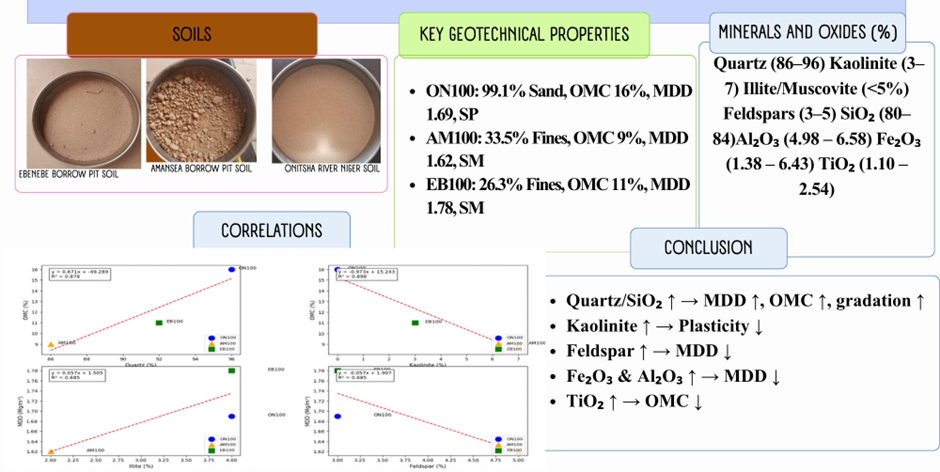
The engineering behavior of soils used for construction in Awka Municipal, Anambra State, Nigeria, is strongly influenced by their mineralogical and chemical composition. This study investigates how these factors affect the basic properties of three commonly used soils: Onitsha River sand (ON100) and borrow-pit soils from Amansea (AM100) and Ebenebe (EB100). Laboratory testing included particle size distribution, Atterberg limits, specific gravity, linear shrinkage, natural moisture content, compaction (OMC and MDD), X-ray diffraction (XRD) for mineral identification, and X-ray fluorescence (XRF) for oxide composition. Quartz was the main mineral in all samples (86–96%), with smaller amounts of kaolinite (3–7%), illite/muscovite (<1–4%), and feldspars (3–5%), while the main oxides were SiO2 (80–84%), Al2O3 (5–6.5%), Fe2O3 (1.4–6.4%), and TiO₂ (1.1–2.5%). Clear patterns showed that quartz and kaolinite had opposite effects on optimum moisture content, illite improved maximum dry density through better packing, feldspars lowered it by producing extra fines during weathering, SiO2 strongly increased MDD, TiO2 sharply reduced OMC, and Al2O3 and Fe2O3 reduced MDD due to cementing and aggregation. The borrow-pit soil contained moderate silt-rich fines but remained almost non-plastic, while the river sand was nearly pure quartz, uniform, and non-plastic. These results show that mineralogical and chemical composition primarily controls the index properties of soils and can be used to predict their engineering behavior