Mechanical performance optimization of thatch grass-based particleboard bonded with Arabic gum binder using Response Surface Methodology
Keywords:
Thatch grass, Arabic gum, Particleboard, Response Surface Methodology, Mechanical properties, Sustainable materials, Life Cycle Assessment, Bio-based adhesiveAbstract
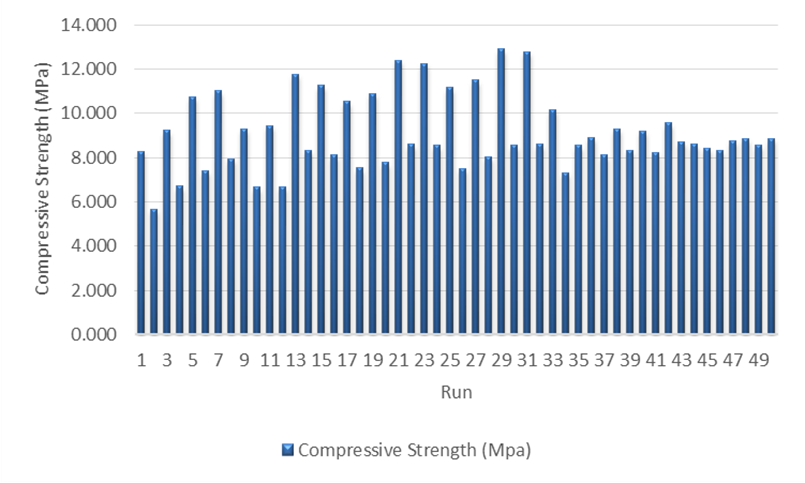
This study investigates the optimization of mechanical and physical properties of particleboard manufactured from thatch grass (Hyparrhenia spp.) bonded with Arabic gum as a bio-based adhesive. The increasing demand for sustainable alternatives to conventional wood-based panels has driven research toward utilizing agricultural residues and natural binders. A Face-Centered Central Composite Design (FCCCD) under Response Surface Methodology (RSM) was employed to optimize five process parameters: particle size, resin loading, press pressure, holding time, and pressing temperature. A total of 50 experimental runs were conducted, and mechanical properties including Modulus of Rupture (MOR), Modulus of Elasticity (MOE), Internal Bond Strength (IB), and Compressive Strength were evaluated alongside physical properties such as density, water absorption, and thickness swelling. The results demonstrated that MOR values ranged from 6.674 MPa to 14.532 MPa, MOE from 1,100 MPa to 2,055 MPa, and IB from 0.120 MPa to 0.420 MPa. The optimized particleboard, produced with particle size of 195.117 μm, resin loading of 43.219%, press pressure of 5 MPa, holding time of 6 minutes, and pressing temperature of 174.988°C, achieved MOR of 13.597 MPa, MOE of 1943.687 MPa, IB of 0.401 MPa, compressive strength of 12.406 MPa, and density of 699.999 kg/m³. Life Cycle Assessment confirmed significantly lower environmental burdens compared to conventional particleboards. The study demonstrates that thatch grass-based particleboard bonded with Arabic gum represents a viable, sustainable alternative to traditional wood-based panels for general-purpose applications.