Fretting wear mitigation: development of wear-resistant coconut shell particulate/aluminium composite
Keywords:
Fretting Wear, Aluminium Matrix Composite (AMC), Mechanical Properties, Tribological Performance, Mitigation Factor.Abstract
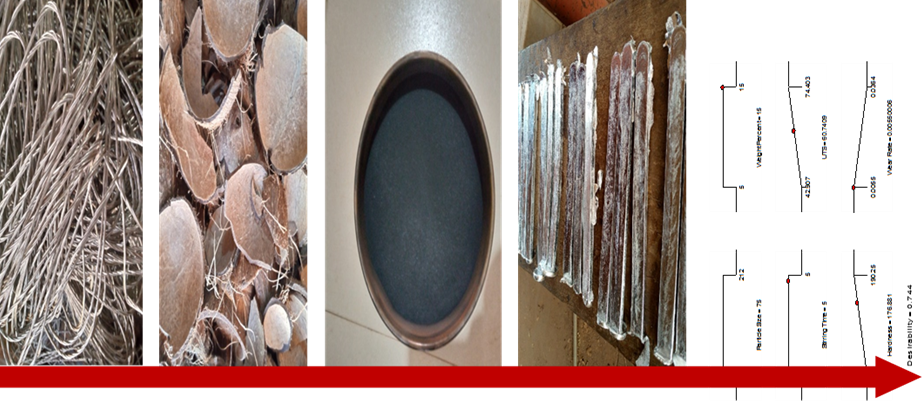
Fretting wear has remained a dominant problem in engineering, and efforts geared towards its mitigation have continued to gain attention within the research community. One of the ways of solving problems of fretting wear is through the design and development of wear-resistant materials, of which aluminium matrix composites are the material employed in this research. Aluminium matrix composites (AMCs) are widely employed in engineering applications requiring high strength-to-weight ratios; however, their mechanical and tribological performances are highly dependent on reinforcement strategy. This study presents a comprehensive evaluation of the mechanical and tribological properties of aluminium matrix composites incorporating carbonised coconut shell particulate reinforcement, using Response Surface Methodology (RSM) as an optimisation framework. Unreinforced aluminium alloy was included as a control sample to establish baseline mechanical and tribological behaviour. Ultimate tensile strength (UTS) and hardness were evaluated as key mechanical responses, while wear rate served as a tribological response. Results demonstrated that reinforcement significantly enhances mechanical and tribological performances relative to the control sample. The UTS values ranged from 42.907 to 74.403 MPa, with maximum strength observed at 212 µm particle size, 15 wt% reinforcement, and 2 minutes of stirring. Hardness reached 190.25 LHN, while wear rate decreased to 0.0055 mm³/m for the composite with 75 m, 15 wt% and 5 min stirring time, demonstrating the positive effect of reinforcement on load-bearing capacity and wear resistance. Compared to pure aluminium, the composite improved UTS by up to 62%, hardness by up to 38%, reduced wear by up to 71%, and mitigated against fretting wear by 15%.