Development of an artificial intelligence model for predicting students’ performance in an engineering department of a Nigerian university
Keywords:
Classification models, Students’ performance prediction, undergraduate admission, Machine learning, Binary classifierAbstract
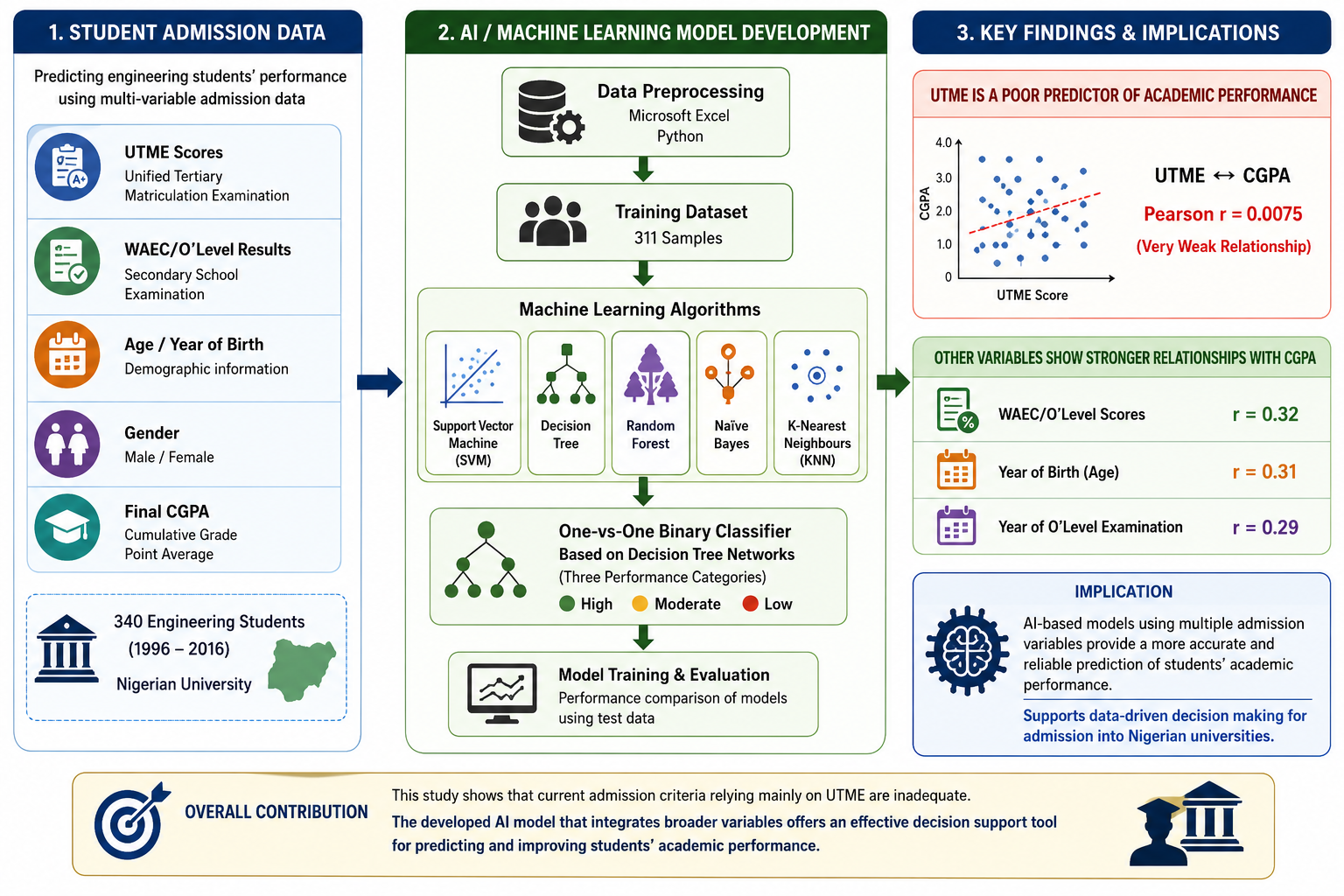
Students seeking admission into Nigerian tertiary institutions are required to possess some requirements. However, the efficacy of these requirements in predicting students’ performance has been a subject of discussion. This study examines the effectiveness of current admission requirements in predicting academic performance among engineering students in a Nigerian university. Using data from 340 students admitted between 1996 and 2016, variables such as age, gender, UTME scores, O’Level results, and final CGPA were analysed. With Microsoft Excel and Python, Data pre-processing was carried out. Multiple machine learning models that include Support Vector Machine, Decision Tree, Random Forest, Naïve Bayes, and K-Nearest Neighbours were developed using 311 training samples. To enhance classification accuracy, a One-Vs-One binary classifier based on Decision Tree networks was implemented for three performance categories. Pearson correlation analysis indicated a very weak relationship (0.0075) between UTME scores and CGPA, signifying that UTME alone is a poor predictor of academic performance. But, WAEC scores (0.32), year of birth (0.31), and year of O’Level examination (0.29) showed relatively stronger correlations with CGPA. The exploratory analysis confirmed that the current admission criteria may be inadequate, and a combination of other factors are likely to be better predictors of students’ performance. The resulting ML model which explored broader variables offers a more effective decision support tool for processing undergraduate admissions in Nigerian universities.