Development of sensitivity index-based technique for unified power flow controller placement with contingency analysis on Nigeria 330Kv transmission network
Keywords:
Development ,sensitivity, index, based, technique, unified, power, flow, controller, placement ,contingency, analysis, Nigeria, 330kv, transmission, networkAbstract
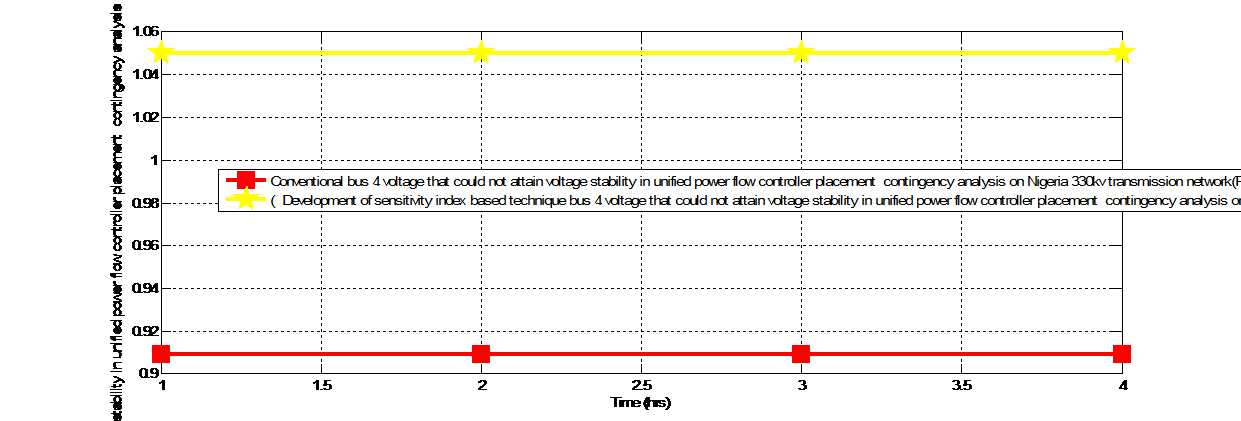
Persistent power failure that disrupted business activities was mainly caused by poor placement of the Unified Power Flow Controller (UPFC) due to voltage instability in the Nigerian 330 kV transmission network. This study developed a Sensitivity Index–Based Technique for Optimal UPFC Placement with Contingency Analysis to improve system stability. Load flow analysis was first conducted to identify weak buses whose voltage levels fell outside the acceptable stability range of 0.95 through1.05 p.u. A conventional UPFC placement model was designed and compared with the proposed sensitivity index–based technique implemented using a SIMULINK model. Results showed that the conventional system produced a bus voltage of 0.909 p.u. at Bus 4 and line loading sensitivity of 75%, indicating instability. However, when the proposed technique was applied, the voltage improved to 1.05 p.u. and line loading sensitivity increased to 90%. This represents a 15% improvement in system performance, demonstrating that the sensitivity index–based technique significantly enhances UPFC placement and voltage stability in the Nigerian 330 kV transmission network.