Fuzzy PID–Based Automatic Irrigation Control for Enhanced Agricultural Performance
Keywords:
Irrigation Systems, Control systems, Fuzzy logic controllers, PID controllers, Matlab/SimulinkAbstract
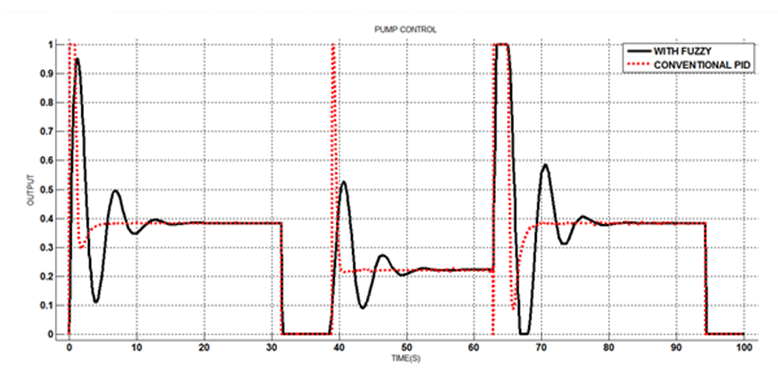
This paper presents a Fuzzy PID–based automatic irrigation control system aimed at improving agricultural performance through intelligent water management. A dynamic model of the irrigation process was developed and implemented in simulation to integrate soil moisture dynamics, crop type, and water flow characteristics. The proposed controller combined conventional PID control with fuzzy logic tuning to enhance adaptability under varying environmental conditions. Simulation studies were carried out to compare the proposed Fuzzy PID controller with a conventional/manual control approach using key performance indices such as response time, overshoot, steady-state error, and moisture regulation accuracy. Results showed that the Fuzzy PID system achieved faster settling time, smoother response, and near-zero steady-state error, with improved soil moisture tracking under different crop conditions. To validate the simulation, an experimental prototype was developed using soil moisture sensors, a microcontroller-based control unit, and an automated pump system. Experimental results closely matched simulation predictions, confirming reliable real-time performance and robustness of the controller. Quantitatively, the proposed system reduced water overflow by 100%, improved soil water level regulation by 21%, optimized water supply rate by 9%, and enhanced pump control efficiency by 22% compared to the conventional method. Overall, the results demonstrated that the Fuzzy PID–based irrigation system provides efficient, stable, and precise water management, making it a viable solution for smart agriculture applications.