Molinillo Seed (Hura crepitans) Subjected to Different Drying Techniques and the Effects on the Bio-oil Quality Potentials
Keywords:
Molinillo seeds, bio-oil yield, renewable energy, drying methods, potential qualitiesAbstract
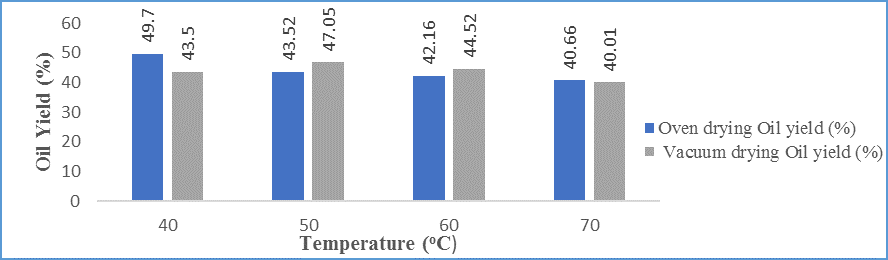
This study assessed the impact of different drying processes on the bio-oil yield and physicochemical parameters of molinillo seed (Hura crepitans), an underused non-edible oilseed with promise for renewable energy applications. Using a complete randomized design with three separate trials, seeds were dried by oven, vacuum, solar and sun, with an undried sample that served as control. Whilst solar and sun drying occurred in ambient settings, oven and vacuum drying were carried out at 40, 50, 60, and 70 °C respectively. Soxhlet extraction with n-hexane was used to extract bio-oil, and the oil yield was calculated. Using conventional AOAC and ASTM procedures, as well as some modified methods, the extracted oils were examined for acid value, saponification value, iodine value, peroxide value, specific gravity, and flash point. Analysis of variance was used to statistically examine the data at an accuracy level of 95%. The findings demonstrated significantly increased oil yield with the oven and vacuum drying, where vacuum drying generally yielded more stable oil, in comparison to solar and sun drying. Oven drying at 40°C yielded the maximum oil output (49.70%), while sun-dried sample yielded the lowest (36.97%). Oils with reduced acid and peroxide values, and improved oxidative stability due to reduced moisture were also, consistently obtained by the vacuum drying. Iodine values (83.0–87.5 g I₂/100 g) and saponification values (193.55–200.30 mg KOH/g) showed suitability of the oil for industrial uses, such as, the manufacturing of soap and biodiesel.