Low-Carbon Reinforced Concrete Beams Using Recycled-Aggregate Concrete and Industrial-Waste Binders: Experimental Bond-Strength and Flexural Performance Assessment
Keywords:
Recycled aggregate concrete; supplementary cementitious materials; Eurocode 2; bond strength; flexural performance; interfacial transition zone; embodied carbonAbstract
The construction sector is one of the largest contributors to global carbon dioxide emissions, with Portland cement
production accounting for roughly 8% of anthropogenic CO2 annually. This paper presents an experimental investigation
into the bond strength and flexural performance of reinforced concrete beams made from recycled coarse aggregate
concrete incorporating industrial-waste supplementary cementitious materials, specifically ground granulated blastfurnace
slag conforming to EN 15167-1, fly ash conforming to EN 450-1, and silica fume conforming to EN 13263-1.
Four concrete mixes were evaluated: a normal concrete control, two recycled aggregate concrete mixes with 50% and
100% coarse aggregate replacement, and a blended-binder mix with 100% recycled aggregate and combined
supplementary cementitious material substitution of 44.4% by cement mass. Beams measuring 150 mm x 250 mm x 2000
mm were tested under four-point bending at 28 days, with companion cylinder and pull-out specimens tested in parallel.
The characteristic compressive strength of the 100% recycled aggregate mix fell 15.8% below the normal concrete control
(34.7 vs. 41.2 MPa), while the blended-binder mix surpassed normal concrete by 5.6% at 43.5 MPa. Experimental bond
strength in the blended-binder mix reached 10.53 MPa, exceeding normal concrete by 7.0%, while the 100% recycled
aggregate mix showed a 16.6% reduction. Eurocode 2 design bond values proved conservative relative to measured results
across all mixes, with the fib Model Code 2010 showing markedly closer agreement. The blended-binder mix achieved an
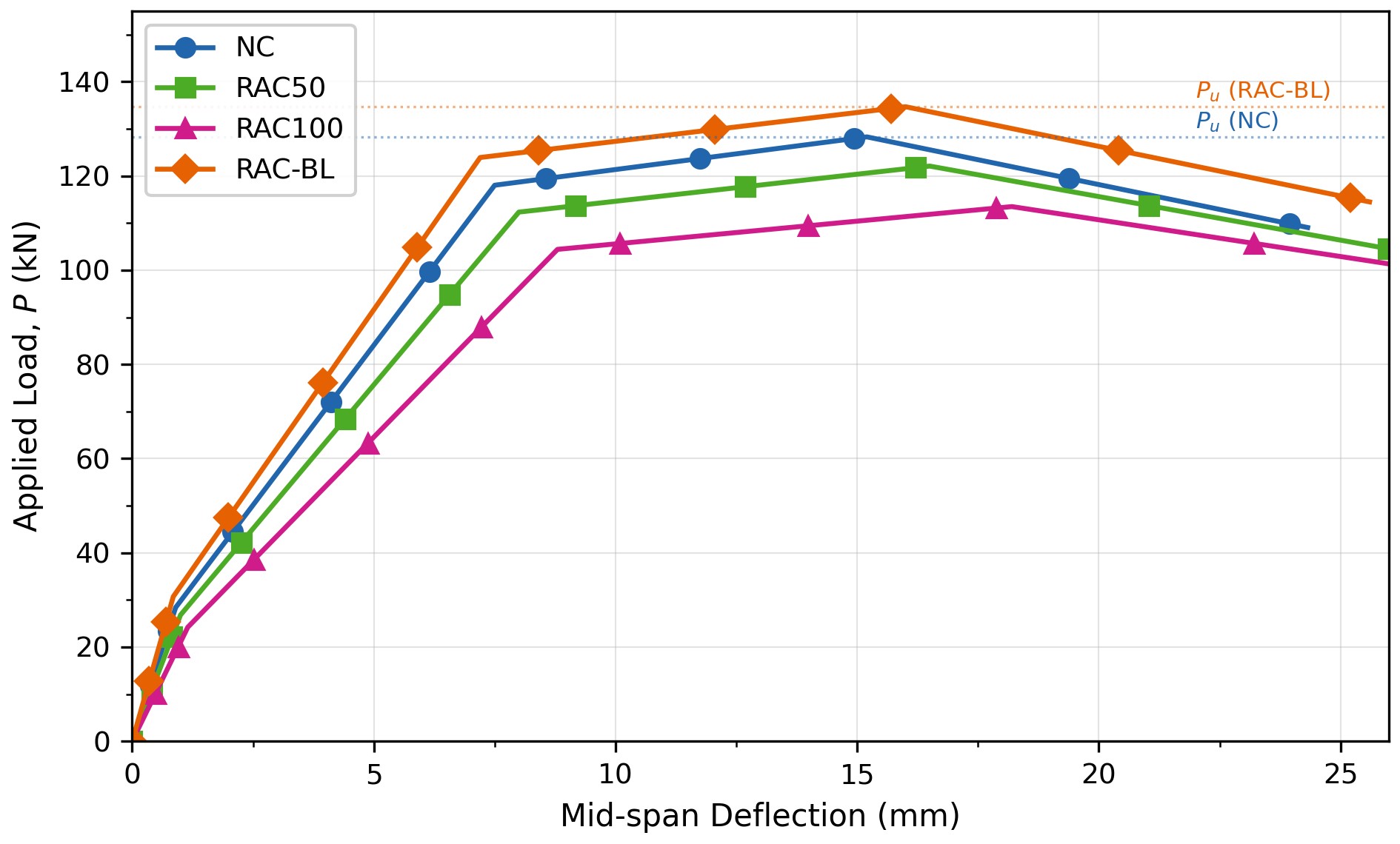
ultimate load of 134.7 kN and a ductility index of 4.12 against normal concrete's 3.41. Embodied carbon analysis confirmed
a 28.3% reduction for the blended-binder mix relative to the normal concrete control.