Steady-State Security and Voltage Stability Assessment of the Nigerian 330 kv Transmission Network
Keywords:
Ferranti Effect; N-1/N-2 Contingency; Newton-Raphson; Nigerian 330 kV Grid; Geospatial Validation; Haversine Formula; Voltage Stability.Abstract
This study presents a comprehensive steady-state vulnerability assessment of the Nigerian 330 kV, 50-bus, 96-line
transmission network, addressing identified gaps in the published power system literature: inadequate dataset validation,
sole reliance on first-order iterative solvers, and the absence of contingency analysis. Three research objectives are pursued:
(i) geospatial verification of published transmission line parameters using the Haversine formula and Google Maps satellite
imagery, specifically the Fakun–Kainji corridor, whose published length of approximately 0.50 km (Bus 34 to Bus 50) is
confirmed as physically correct by GPS-corroborated field coordinates; (ii) correction of systematically erroneous shunt
susceptance values in the dataset of Ugwuanyi et al. (2024), wherein published B values were found to represent series
branch admittance rather than shunt charging susceptance; and (iii) capping of Bus 45 (Geregu) generation at its
documented 435 MW installed capacity. This research utilizes MATLAB 2023a with the MATPOWER 8.1 toolbox to
implement a robust Newton-Raphson power flow solver, independently cross-validated using PandaPower, The corrected
and validated base case yields a total active power loss of 55.54 MW (system efficiency: 98.78%) and identifies five buses
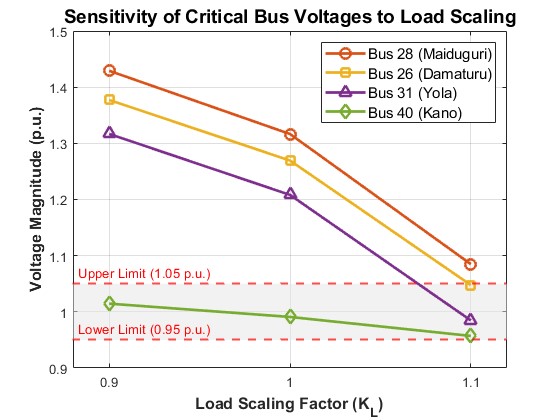
with critical overvoltage violations driven by the Ferranti Effect: Maiduguri/Bus 28 (1.3166 p.u., +0.2666 p.u. above limit),
Damaturu/Bus 26 (1.2694 p.u.), and Yola/Bus 31 (1.2082 p.u., highest L-index: 0.6603). Sensitivity analysis under load
scaling (KL = 0.9 to 1.1) confirms that overvoltage severity is inversely proportional to loading level, intensifying under
light-load conditions. N-1 contingency analysis of all 96 lines identifies Lines 79 and 80 (Lafia–Jos) as the most critical
converged outages (max FVSI = 0.9916), while eight lines cause voltage collapse upon individual removal. N-2 analysis
identifies the simultaneous outage of Lines 19 and 79 as the most severe credible dual-contingency scenario (max FVSI =
1.0174). These findings confirm that the North-East corridor is structurally vulnerable and that the Lafia–Jos parallel
circuits represent the system’s single greatest reliability risk. Immediate deployment of shunt reactors at Maiduguri and
Damaturu and reinforcement of the Lafia–Jos corridor are strongly recommended.