MODELING AND OPTIMIZATION OF THE NOZZLE POSITION OF A CROSS-FLOW HYDRO TURBINE USING BOX-BEHNKEN DESIGN AND MACHINE LEARNING TECHNIQUES
Keywords:
Crossflow turbine, Box-Behnken design, Machine learning, Nozzle position, Optimization.Abstract
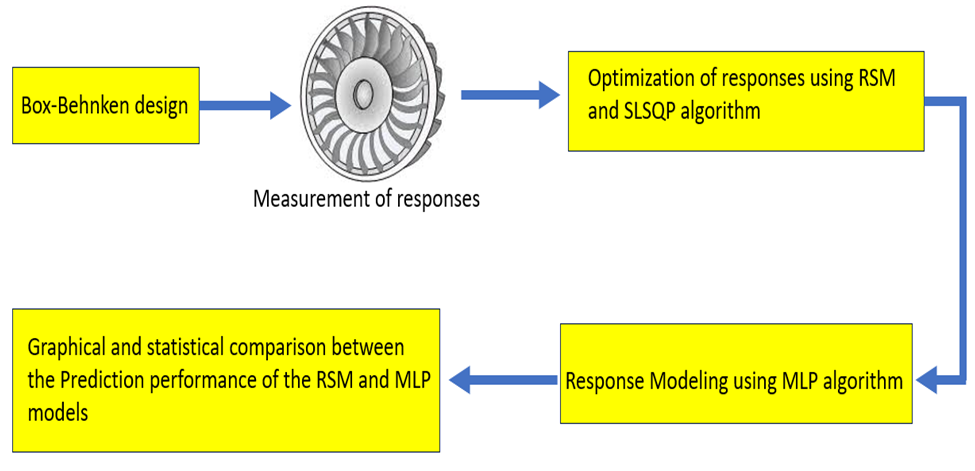
This study employed the Box-Behnken design and machine learning techniques to model and optimize the nozzle position of a cross-flow turbine system. The Box-Behnken design was used to structure the experiment, with nozzle height (365 mm–461 mm), nozzle distance (102 mm–202 mm), and attack angle (0°–40°) as the predictors (independent factors), and efficiency, shaft power, and runner speed as the response variables. A total of 17 experimental runs were obtained from the Box-Behnken design. The experimental design was meticulously followed. The runner speed was measured using a digital tachometer and recorded for each nozzle positional setting, while the shaft power and efficiency were calculated using the appropriate formulae. The responses were optimized, modeled, and analyzed statistically using ANOVA to assess how the nozzle positional factors individually and interactively affect the responses. The results of the RSM optimization were validated using the machine learning algorithm, Sequential Least Squares Programming (SLSQP). Additionally, the responses of the cross-flow turbine were modeled using the Multilayer Perceptron (MLP) algorithm, and its prediction performance was compared to that of the RSM model. This comparison was conducted both graphically and statistically using performance indices such as mean bias error (MBE), root mean square error (RMSE), Nash-Sutcliffe efficiency (NSE), t-statistic, coefficient of correlation (r), and coefficient of determination (). The study results showed that each nozzle positional factor influences the efficiency, shaft power, and runner speed of the CFT system. Additionally, it was observed that the nozzle height and attack angle interactively affect the CFT responses. Using the RSM optimization technique, the optimal nozzle position was determined to be: nozzle height = 408.4mm, nozzle distance = 102mm, and attack angle = 5°. At this position, the predicted response values were: efficiency = 91.91%, shaft power = 242.367W, and runner speed = 406rpm. The SLSQP technique validated the RSM findings by identifying a similar optimal nozzle position: nozzle height = 407.99mm, nozzle distance = 102mm, and attack angle = 4.699°. At this position, the predicted response values were: efficiency = 91.962%, shaft power = 242.599W, and runner speed = 405.99rpm. Furthermore, holistic modeling of the CFT system demonstrated that both RSM and MLP models performed well in estimating CFT responses. However, the RSM model surpassed the MLP model, as it had lower MBE, RMSE, and T-statistic values and higher NSE, r, and values. Consequently, the developed RSM model is recommended for predicting CFT responses across different nozzle positional factors.