Unlocking the Potential: A Detailed Characterization of n-Hexane Extracted Sweet Orange Seed Oil as a Sustainable Industrial Feedstock
Keywords:
Soxhlet Extraction, sustainable biodiesel, sweet orange, Bio-industrial Feedstock.Abstract
This study conducted an extensive characterization of sweet orange seed oil (SOSO), extracted using the Soxhlet method
with n-hexane, to evaluate its potential as a feedstock for industrial applications. The extraction produced 41.64% (w/w)
of a light-yellow oil containing 0.249% moisture. The characterization revealed that at 40 °C, the kinematic viscosity was
29.450 mm²/s, the refractive index was 1.437 at 30 °C, and the acid value was 9.24 mgKOH/g, indicating a free fatty acid
(FFA) content of 4.67 mgKOH/g. The iodine value was determined to be 107.78 meq/100g, suggesting the oil is highly
unsaturated. Further tests showed a saponification value of 243.446 mgKOH/kg, a peroxide value of 0.410 meq/g, a
specific gravity of 0.920, and a molecular weight of 1114.68 g/mol. The thermal properties included a flash point of 217
°C, a cloud point of 12.0 °C, and a melting point of 3.5 °C. The ester value was 62.019%. The physicochemical properties
closely matched those specified in ASTM D6751f, indicating that SOSO could serve as a non-edible substitute for
conventional vegetable oils. Gas Chromatography-Mass Spectrometry (GC-MS) analysis showed that 71.35% of the fatty
acids were unsaturated, primarily Oleic (4.34%) and Linoleic acids (67.01%), suggesting excellent cold-flow properties
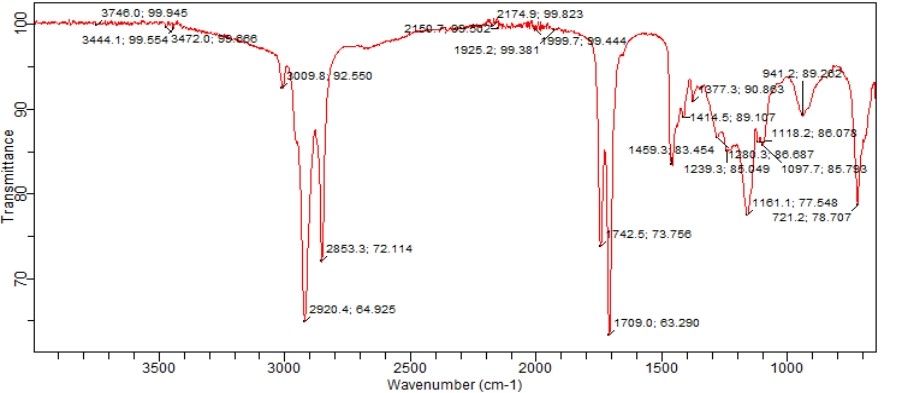
and high reactivity for chemical conversion. Additionally, Fourier Transform Infrared (FTIR) spectroscopy identified
characteristic ester functional groups at 1745 cm-1, with the C=O (carbonyl) stretching vibration indicating good structural
integrity. This comprehensive study concludes that the oil has favorable properties for long-term use across various
industries, particularly in biodiesel and bio-lubricant production.