DESIGN AND SIMULATION OF A 1KW WIRELESS POWER TRANSFER SYSTEM FOR A 5-MILE SINGLE-PHASE RURAL MICROGRID
Keywords:
Wireless Power Transfer (WPT) system, hybrid solar photovoltaic, resonant inductive coupling, Phase-angle tracking and pulse-width modulation (PWM) control.Abstract
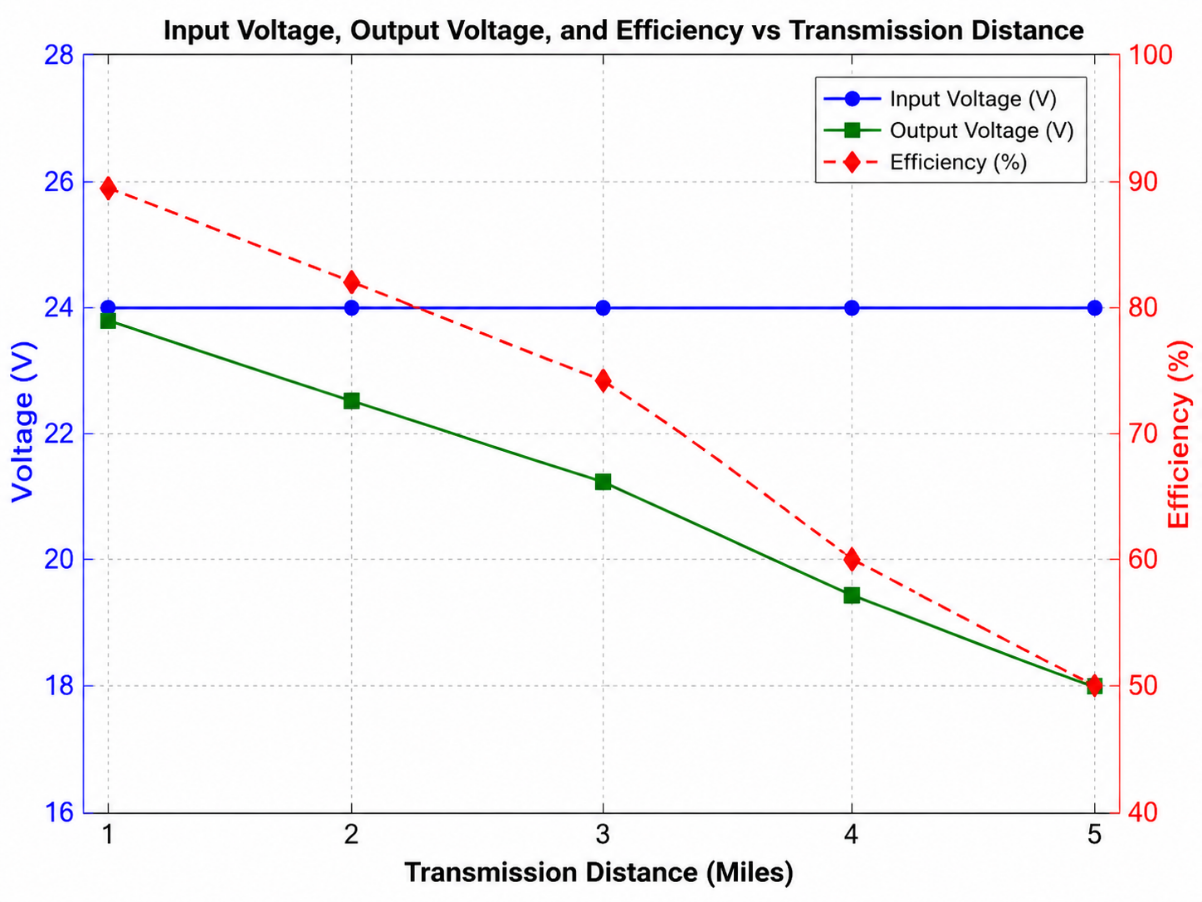
This study demonstrated the design and simulation of a 1kW Wireless Power Transfer (WPT) System for a 5-Mile Single-Phase Rural Microgrid using MATLAB/Simulink R2025. The objective was to investigate the feasibility of transmitting electrical energy wirelessly for rural electrification applications. The developed model comprised a 6.6 kWp solar photovoltaic array, a 24 V, 2000 Ah lithium-ion battery bank, an MPPT controller, a 1kW high-frequency inverter operating at 100 kHz, resonant transmitter and receiver coils, a wireless transmission channel, and a control and protection subsystem. Simulation results demonstrated successful wireless power transmission across the entire simulated distance of 5 miles (8.05 km). The system achieved a maximum efficiency of 89.5% at 1 mile, which decreased to 82.0%, 74.0%, 60.0%, and 50.0% at 2, 3, 4, and 5 miles, respectively. The output voltage also reduced from 23.8 V at 1 mile to 18.0 V at 5 miles, while the input voltage remained constant at 24 V. These results confirmed that increasing transmission distance reduces magnetic coupling and overall power transfer efficiency. Load testing showed that the system maintained stable operation for load demands ranging from 200 W to 1000 W, while magnetic field analysis revealed a decrease in field strength from 4.8 mT at 1 mile to 0.3 mT at 5 miles. The control and protection subsystem successfully maintained resonance tracking and stable power delivery under varying operating conditions. The findings demonstrated the technical feasibility of employing wireless power transfer technology for rural microgrid applications. The developed simulation model achieved efficient power transmission, stable operation, and satisfactory performance across the simulated transmission range, thereby establishing a foundation for future optimization and practical implementation of WPT-based rural electrification systems.