Effects of Welding Current on the Mechanical and Microstructural Properties of Gas Metal Arc Welded 304 Austenitic Stainless-Steel Joints
Keywords:
Austenitic stainless steel; Gas metal arc welding; Welding current; Heat input; MicrostructureAbstract
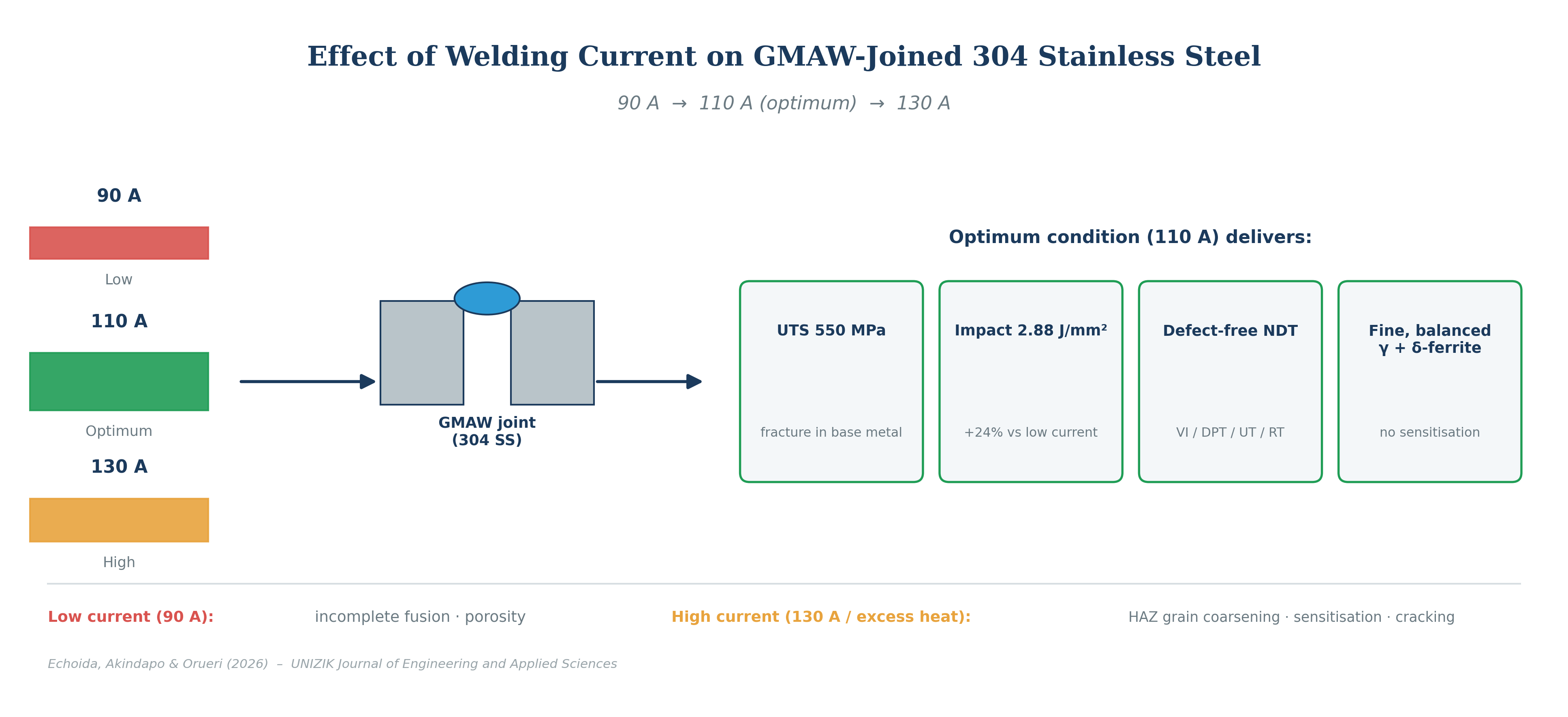
This study evaluates the effect of welding current on the mechanical properties, microstructure, defect formation, and chemical composition of 304 austenitic stainless-steel joints produced by gas metal arc welding (GMAW). Plates were welded at 90 A, 110 A, and 130 A, with arc voltage, welding speed, and electrode type held constant to isolate the effect of current on heat input. Welded specimens underwent tensile, impact, and hardness testing, metallography, non-destructive testing (NDT), and optical emission spectrometry (OES) analysis. The 110 A specimen performed best overall, with the highest ultimate tensile strength (550 MPa), yield strength (420 MPa), and impact energy absorption (72 J), fracturing in the base metal rather than the weld. Hardness rose in the weld metal with increasing heat input while the heat-affected zone (HAZ) softened correspondingly. Excessive current caused HAZ grain coarsening and, at higher heat input, carbide precipitation and sensitization; insufficient current produced incomplete fusion and porosity. NDT confirmed 110 A welds were essentially defect-free, while low- and high-heat-input welds showed porosity and surface cracking, respectively. OES confirmed parent and weld metal conformed to the standard composition of Grade 304 stainless steel. Welding current is thus established as a controlling variable in weld integrity, with 110 A identified as the optimum condition for mitigating weld cracking in industrial fabrication.