Optimization and Prediction of Heat Affected Zone Width of Mild Steel Weldment using Response surface methodology
Keywords:
current, voltage, weld speed, weldment, width, polynomial.Abstract
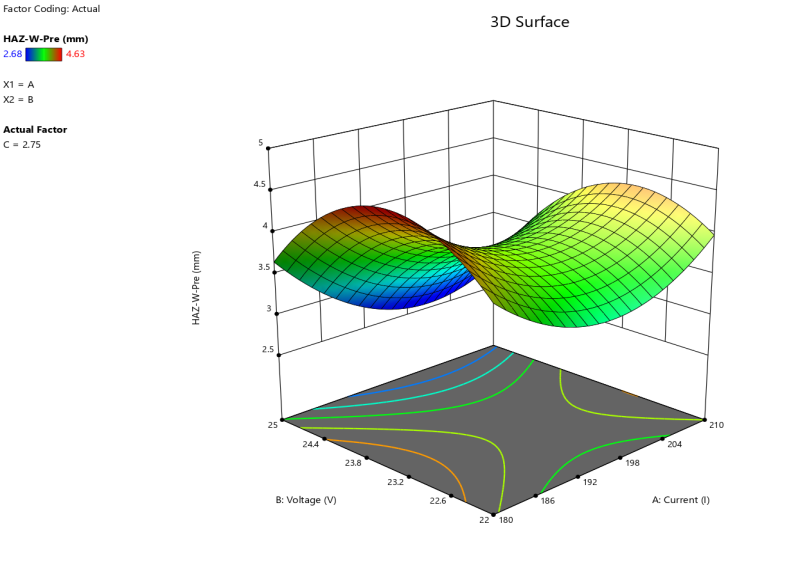
The optimization of welding process parameters to simultaneously control Heat Affected Zone (HAZ) width in mild steel weldments remains a persistent challenge due to complex, nonlinear thermal-metallurgical interactions that are inadequately captured by conventional empirical modeling approaches. This study aimed to develop and validate Response Surface Methodology (RSM) for optimizing Gas Metal Arc Welding (GMAW) of mild steel to enhance prediction accuracy and multi-response optimization capability. The primary objectives were to quantify the influence of welding current, voltage, and travel speed on weld HAZ width, A Central Composite Design comprising twenty experimental runs was employed to systematically investigate the effects of three input factors: welding current (180–210 A), voltage (22–25 V), and weld speed (2.0–3.5 mm/s). Quadratic polynomial models were developed using Response Surface Methodology in Design-Expert software. Multi-objective optimization was performed using the desirability function approach within RSM. All optimized parameter combinations were experimentally validated through confirmation runs, with statistical diagnostics including the coefficient of determination (R²), adjusted R² (94.52%), predicted R², lack-of-fit tests, and residual analysis used to assess model adequacy and predictive reliability.