Volatile Organic Compound Emissions from Degrading Micro- and Nanoplastics: A Survey of the Unseen Footprint and Its Global Climate Feedbacks
Keywords:
volatile organic compounds; microplastics; nanoplastics; emissions; secondary organic aerosol; climate change.Abstract
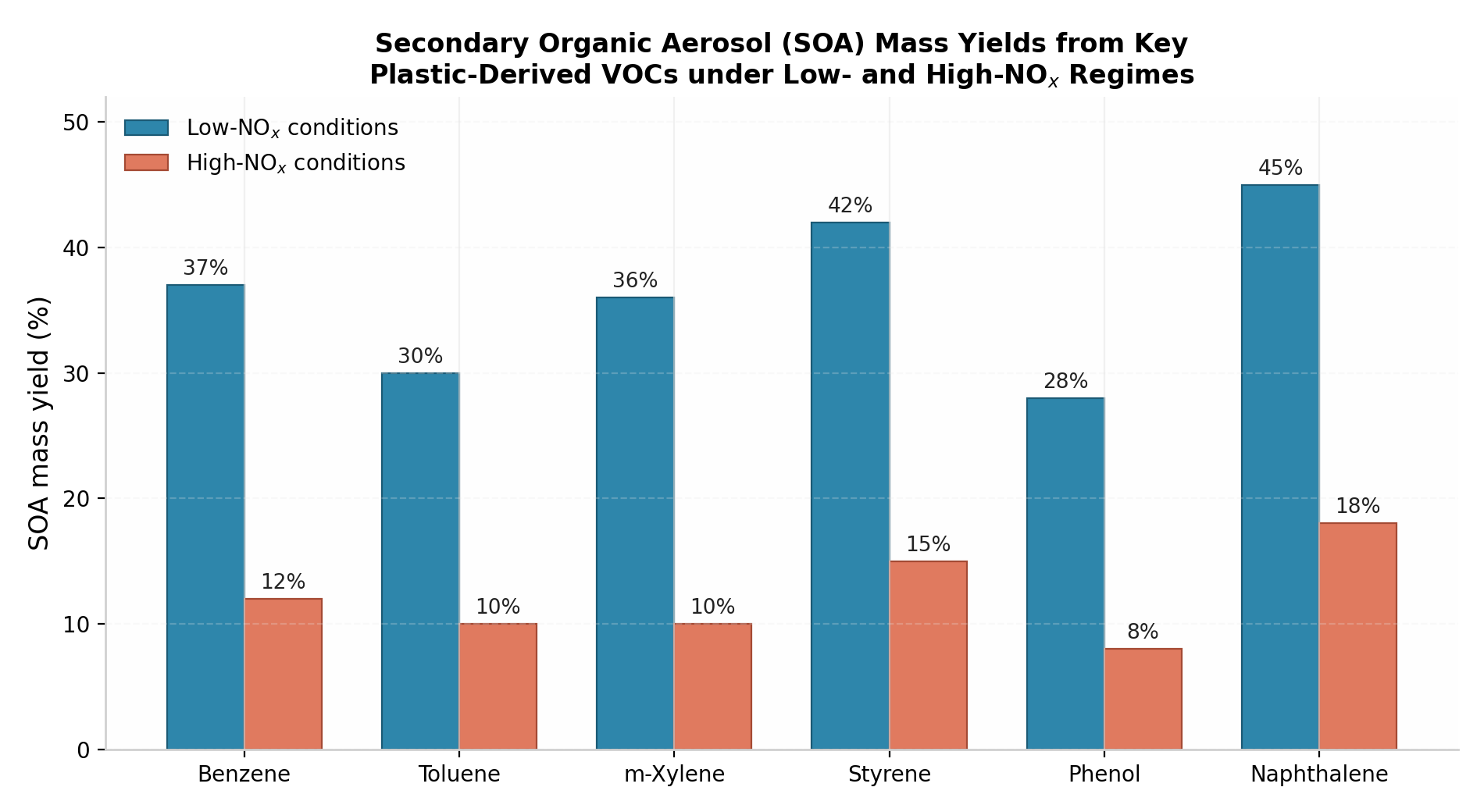
The spread of microplastics (MPs; <5 mm) and nanoplastics (NPs; <1 μm) through land, sea, and air now ranks among the most stubborn environmental problems of the Anthropocene. Although the visible, physical side of plastic pollution is well documented, far less attention has been paid to the volatile organic compounds (VOCs) that plastics give off as they break down. This review pulls together what is currently known about how, how much, and with what climatic consequences VOCs escape from degrading micro- and nanoplastics. A structured search of the Scopus, Web of Science, ScienceDirect, and Google Scholar databases for literature published between 2015 and 2025 provided the evidence base. When plastics are exposed to sunlight, heat, mechanical wear, and microbes, polymer chains crack and oxidize, releasing a mixture of volatile compounds. Aromatic hydrocarbons benzene, toluene, ethylbenzene, xylenes (BTEX), styrene, and naphthalene dominate this mixture, and emission rates depend strongly on the polymer, the temperature, and the intensity of irradiation. Polystyrene gives off the most styrene monomer per unit area (up to 0.152 ng cm⁻² hr⁻¹ under UV), whereas polyvinyl chloride releases large amounts of chlorinated organics and plasticizer-derived compounds. Once airborne, these plastic-derived VOCs feed the formation of secondary organic aerosol (SOA), with mass yields of 30–45% for key aromatic precursors under low-NOₓ conditions. The ecological stakes are high: marine organisms must cope simultaneously with ingested microplastics, leached additives, and VOC-driven toxicity, while contaminated soils show shifted microbial communities, higher greenhouse gas (N2O, CH4, CO2) emissions, and weaker plant growth. Most importantly, the relationship runs both ways. A warmer climate speeds up plastic degradation, pushing VOC emission rates up exponentially (Q10 values of 2.1–3.4 for key compounds); those emissions then feed SOA formation and radiative forcing, which warms the climate further. The review closes by mapping the main knowledge gaps global VOC fluxes from plastic degradation remain unmeasured, nanoplastics are unstudied as SOA precursors, and Earth system models ignore plastic–climate interactions altogether and proposes a research agenda built around standardized emission protocols, long-term field observation, and coupled plastic–climate modelling.