Microalgae Lipid Accumulation: Dynamic Modelling and Optimal Control for Biojet Fuel Production
Keywords:
algae; harvesting; sustainable aviation fuel; biofuel; sensitivity analysisAbstract
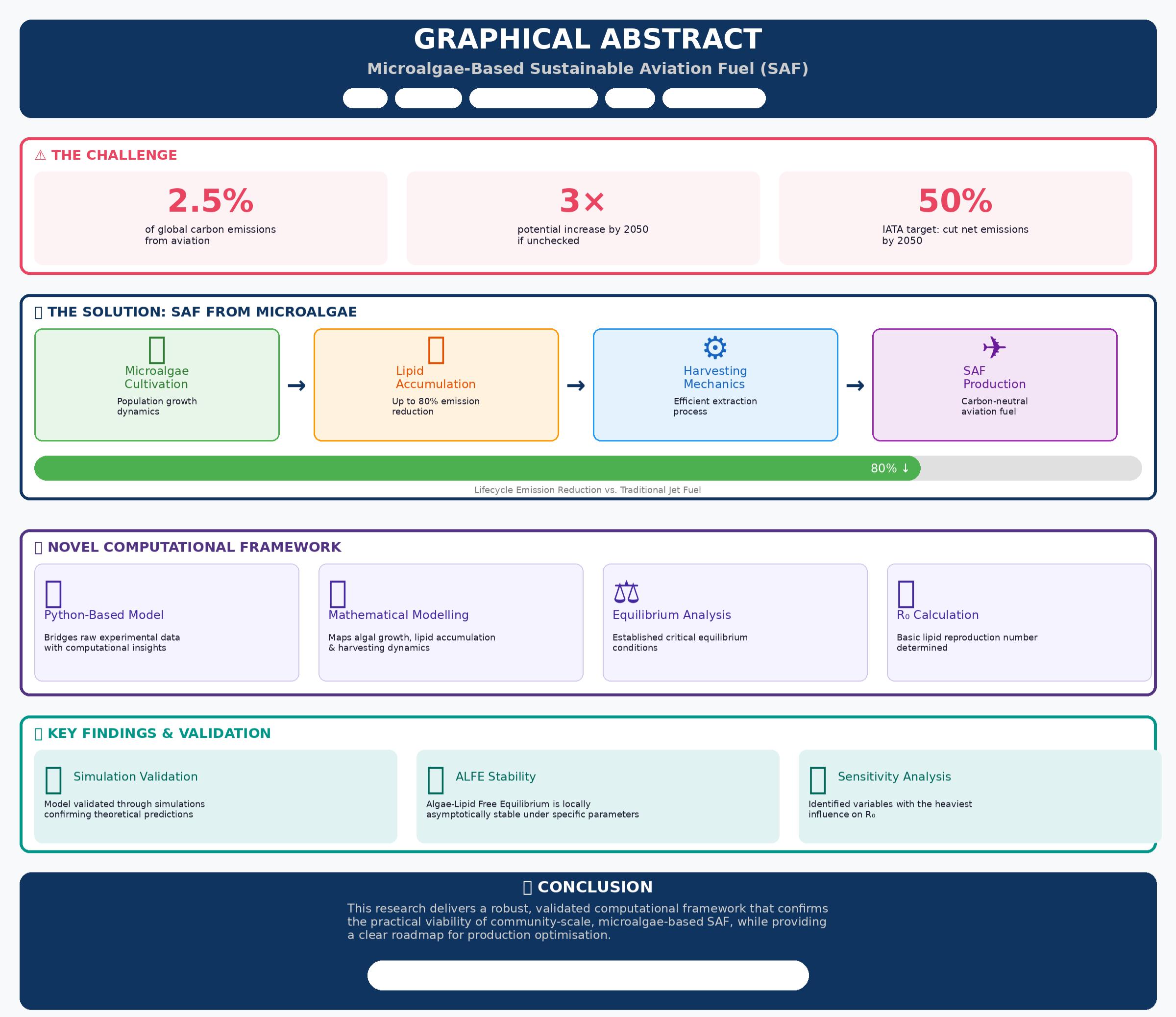
The global aviation sector is a major driver of climate change, currently generating roughly 2.5% of the world's carbon emissions—a figure that could easily triple by 2050 if left unchecked. To combat this, the International Air Transport Association (IATA) has set aggressive decarbonization goals, pushing for carbon-neutral growth and a 50% cut in net emissions by 2050 compared to 2005 benchmarks. Sustainable Aviation Fuel (SAF) stands out as the most practical, immediate solution to reduce the industry's carbon footprint, offering up to an 80% reduction in lifecycle emissions compared to traditional jet fuel. To unlock this potential, this study bridges the gap between raw experimental data and computational insights by developing a novel Python-based mathematical model to analyse microalgal lipid production. The framework successfully maps out the intricacies of algae population growth, lipid accumulation, and harvesting mechanics. Through this model, we established critical equilibrium conditions and calculated the basic lipid reproduction number (R0). Our simulations validated the model, proving that the Algae-Lipid Free Equilibrium (ALFE) remains locally asymptotically stable under specific parameters. Furthermore, a sensitivity index analysis was conducted to determine which variables most heavily influence R0. Ultimately, this research delivers a robust, validated computational framework that confirms the practical viability of community-scale, microalgae-based SAF while providing a clear roadmap for production optimisation.