Optimization of Microwave-Dried African Breadfruit (Treculia Africana) Seeds for Nutrient Quality Using Single-Factor Response Optimization
Keywords:
African breadfruit, microwave drying, single-factor optimization, nutrient retention, drying kinetics.Abstract
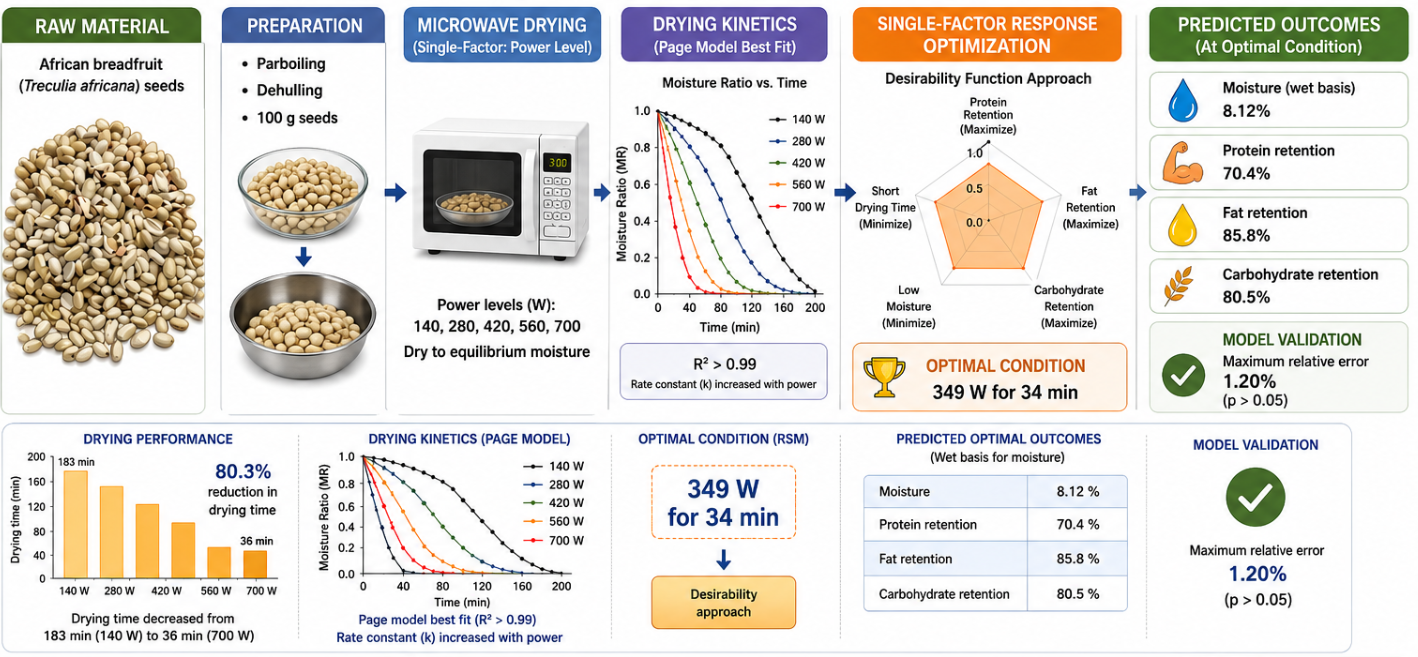
African breadfruit (Treculia africana) seeds are nutritionally valuable but underutilized due to poor post-harvest handling. This study optimized microwave drying parameters using a single-factor response optimization approach. Parboiled and dehulled seeds (100 g) were dried at five power levels (140–700 W) until equilibrium moisture was achieved. The Page model provided the best fit among five classical models tested (R² > 0.99), with drying time decreasing from 183 to 36 min (80.3% reduction) as power increased. Effective moisture diffusivity increased 6.9-fold from 1.58 × 10⁻⁹ to 1.09 × 10⁻⁸ m²/s, with apparent activation energy of 15.12 kJ/mol. Multi-response optimization using the desirability function identified 349 W as optimal, with corresponding drying time of 34 min derived from kinetics. The optimized conditions predicted 8.12% moisture (wet basis), 47.1% protein retention relative to fresh seeds (70.4% relative to optimization constraints), 85.8% fat retention, and 80.5% carbohydrate retention on dry matter basis. Validation confirmed model accuracy with maximum error of 1.20% (p > 0.05). Colour measurements (ΔE* = 12.8) and lipid oxidation parameters (peroxide value = 2.1 meq O₂/kg) confirmed quality preservation at optimized conditions, while SEM analysis revealed superior structural integrity compared to 700 W drying. Compositional changes resulted from volumetric heating, protein denaturation, Maillard reactions, lipid oxidation, and concentration effects. Microwave drying at 349 W for 34 min is recommended for pilot-scale evaluation, offering significant time savings (81.4% reduction vs. 140 W), process efficiency, and preserved nutritional quality. The single-factor optimization context provides a transferable methodological approach for evaluating drying processes of other underutilized African crops.