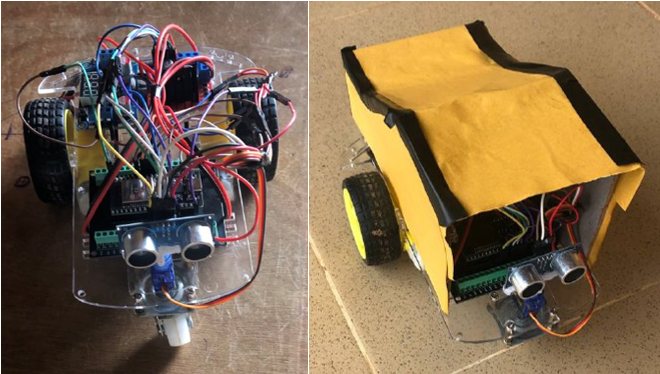
OPTIMIZATION OF AN OBSTACLE AVOIDING ROBOT USING REINFORCED LEARNING
Keywords:
Obstacle Avoidance, Q-Learning, Autonomous Robot, ESP32, Reinforcement Learning, Embedded Systems.Abstract
This study presents the design, implementation, and performance evaluation of an obstacle-avoiding robot optimized with Artificial Intelligence using the Q-learning reinforcement learning algorithm for autonomous navigation in dynamic environments. The system was developed using low-cost embedded components, including an ESP32 microcontroller, HC-SR04 / sensor, L298N motor driver, and DC motors, programmed through the Arduino IDE within a state-action-reward learning framework. Experimental evaluation was conducted in a 2 × 2 m indoor test arena under varying obstacle densities over 100 navigation trials. Performance metrics considered include success rate, response time, reliability, navigation efficiency, and battery endurance. Results obtained showed that the robot achieved an 87% obstacle-avoidance success rate, an average response time of 180 ms, 88% operational reliability, and a navigation speed of 45 cm/s. Out of the 100 trials conducted, 13 failed due to ultrasonic sensor latency (10 cases) and software processing delays (3 cases). The findings demonstrate that the integration of reinforcement learning with embedded robotic systems can significantly improve autonomous navigation performance while maintaining low implementation cost. However, the study was limited to indoor environments with static and low-density obstacles. The developed system is suitable for educational, surveillance, and lightweight logistical applications, with future improvements recommended through the integration of LiDAR and advanced sensor fusion techniques.