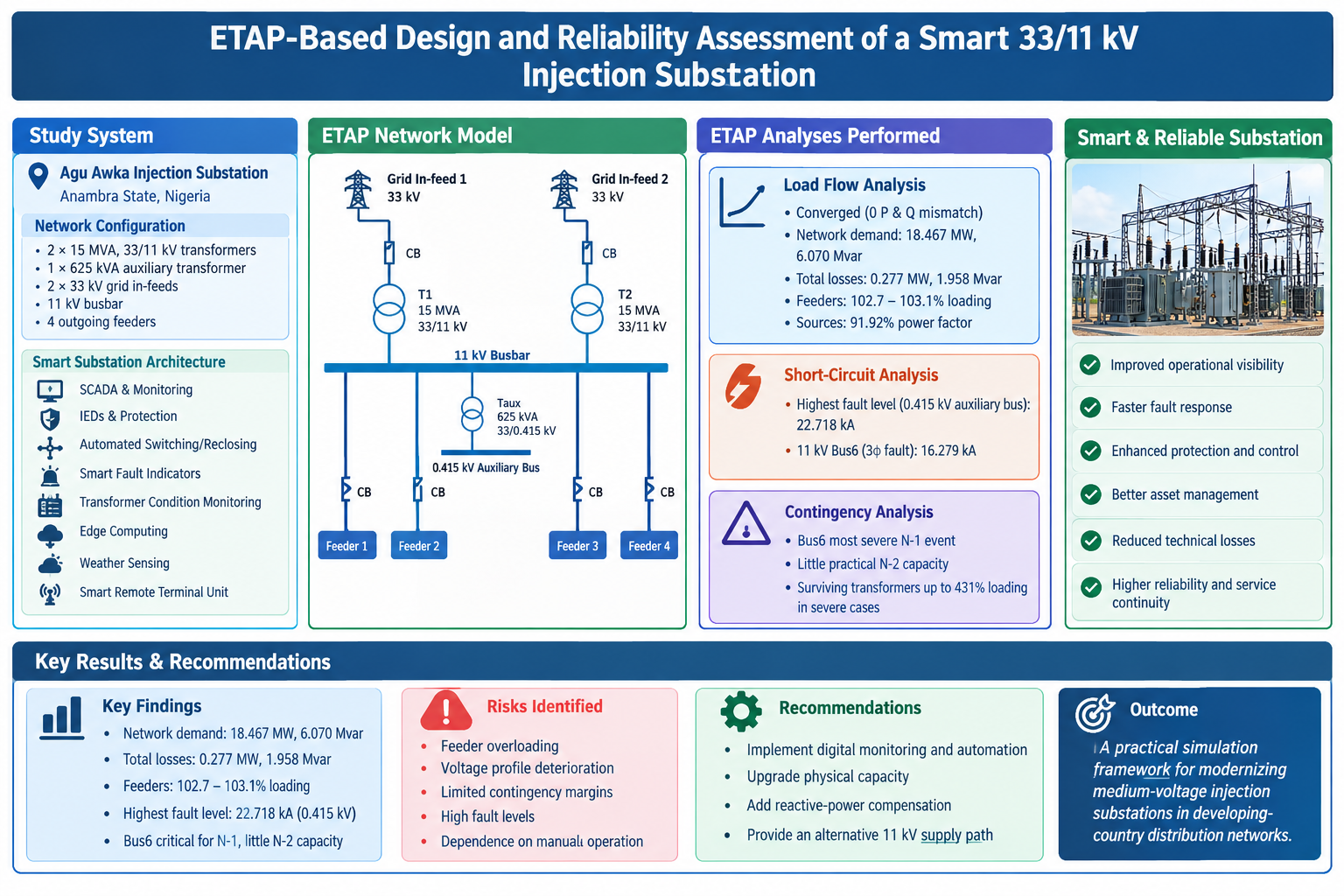
ETAP-Based Design and Reliability Assessment of a Smart 33/11 kV Injection Substation
Keywords:
Smart Substation, Injection Substation, ETAP, Distribution Automation, Load flow, Short-circuit Analysis, Contingency Analysis, IEC 61850, Agu Awka.Abstract
Medium-voltage injection substations are critical interfaces between transmission supply and distribution feeders, yet many networks in developing power systems continue to experience feeder overloading, voltage-profile deterioration, limited operational visibility, and weak contingency margins. This paper presents an ETAP-based design and assessment of a smart 33/11 kV injection substation using the Agu Awka Injection Substation in Anambra State, Nigeria, as the study system. A detailed network model comprising two 15 MVA, 33/11 kV transformers, a 625 kVA auxiliary transformer, two 33 kV grid in-feeds, an 11 kV busbar, and four outgoing feeders was developed. The proposed smart architecture incorporates supervisory control and data acquisition, intelligent electronic devices, automated switching/reclosing, smart fault indicators, online transformer condition monitoring, edge computing, weather sensing, and a smart remote terminal unit. Newton–Raphson load-flow analysis, multi-fault short-circuit analysis, and N-1/N-2 contingency screening were performed. The base case converged with zero active- and reactive-power mismatch. The network demand was 18.467 MW and 6.070 Mvar, while total losses were 0.277 MW and 1.958 Mvar. The four outgoing feeders operated at approximately 102.7–103.1% of their stated ratings, while the two 33 kV sources operated at 91.92% power factor. The highest reported symmetrical fault level occurred at the 0.415 kV auxiliary bus (22.718 kA), while the 11 kV Bus6 recorded approximately 16.279 kA for the three-phase fault case. Contingency screening identified Bus6 as the most severe N-1 event and showed that the network has little practical N-2 capacity, with surviving transformers reaching approximately 431% loading in severe cases. The results indicate that digital monitoring and automation should be implemented together with physical capacity reinforcement, reactive-power compensation, and an alternative 11 kV supply path. The study provides a practical simulation framework for modernization of medium-voltage injection substations in developing-country distribution networks.