Non-Isothermal Thermal Degradation Kinetics of Cerbera odollam Seed Oil
Keywords:
Cerbera odollam seed oil; thermogravimetric analysis; thermal degradation; isoconversional kinetics; Advanced Vyazovkin; activation energy; non-isothermal kinetics.Abstract
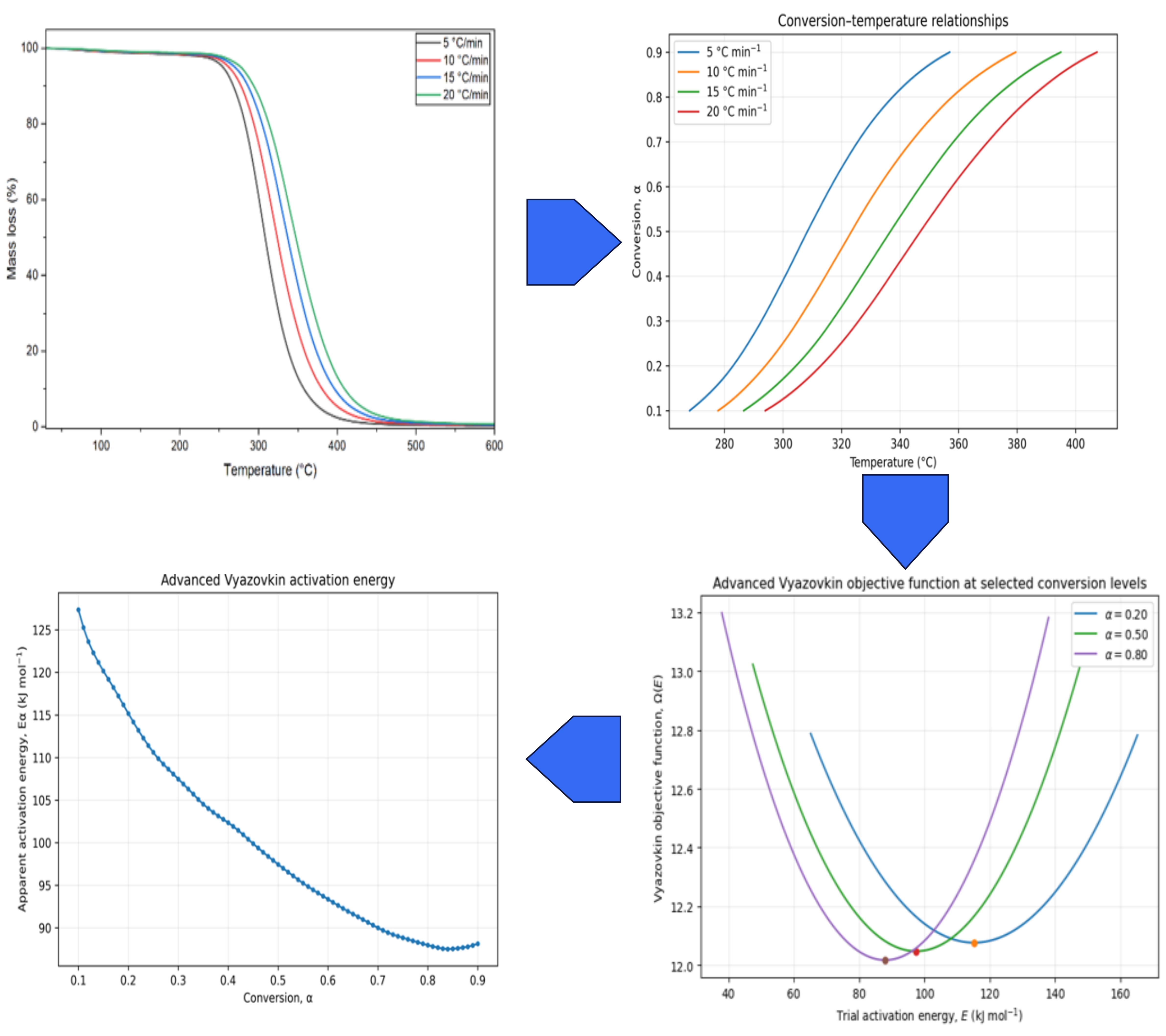
The thermal degradation kinetics of refined non-edible Cerbera odollam seed oil were investigated under non-isothermal conditions using thermogravimetric analysis (TGA) and the Advanced Vyazovkin isoconversional method. TGA measurements were conducted at nominal heating rates of 5, 10, 15 and 20 °C min⁻¹ over the investigated temperature range. Increasing the heating rate progressively shifted the principal degradation region toward higher temperatures, with the DTG peak temperature increasing from 310 °C at 5 °C min⁻¹ to 340 °C at 20 °C min⁻¹. The Advanced Vyazovkin objective functions exhibited well-defined approximately parabolic profiles with distinct minima at the investigated conversion levels, confirming the suitability of numerical minimization for determining the apparent activation energy. The apparent activation energy decreased with increasing conversion, with representative values of approximately 115.17 kJ mol⁻¹ at α = 0.20, 97 kJ mol⁻¹ at α = 0.50 and 88 kJ mol⁻¹ at α = 0.80. This progressive decrease demonstrates that the apparent kinetic barrier for degradation is conversion dependent rather than constant throughout the degradation process. The results establish a non-isothermal thermal degradation profile and conversion-dependent kinetic fingerprint for C. odollam seed oil, providing useful thermal kinetic information for its consideration as a non-edible industrial feedstock and for subsequent thermally processed applications.