Genetic Algorithm-Based Optimal Placement of a Static Var Compensator for Transmission Loss Reduction in the Nigerian 330 kV Grid
Keywords:
genetic algorithm; Nigerian 330kV grid; power loss reduction; reactive power compensation; static Var compensator; transmission system.Abstract
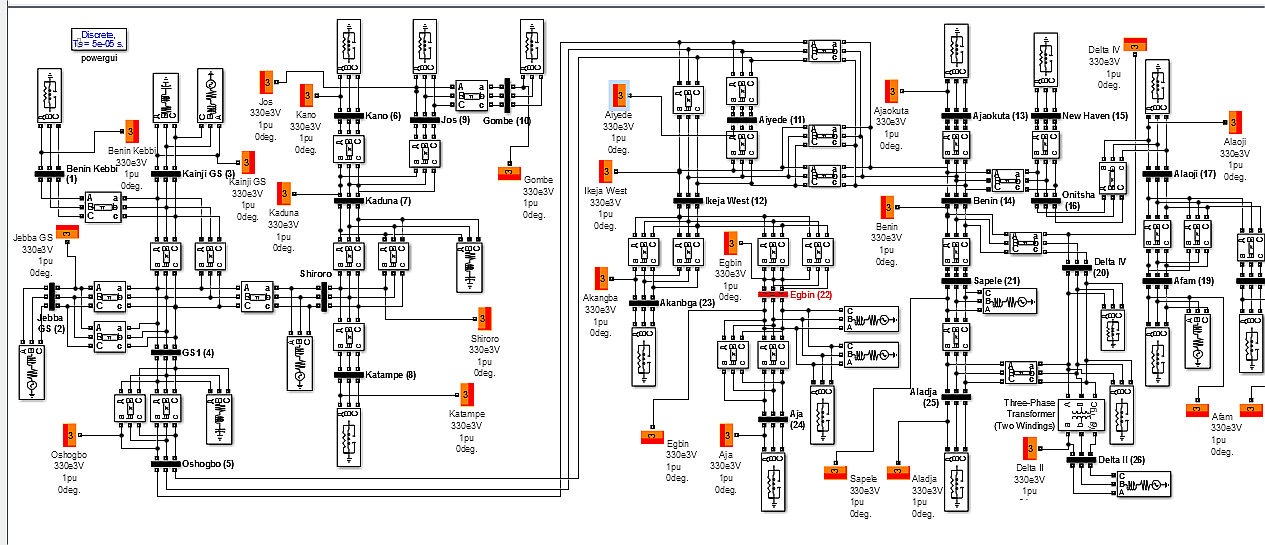
This study evaluates genetic algorithm (GA)-based placement of a static Var compensator (SVC) for reducing active and reactive transmission losses in a MATLAB/Simulink model of the Nigerian 330kV transmission grid. The 26-bus network comprises 37 lines, 9 generators and 19 load points. Fast-decoupled power flow was used for steady-state analysis, while eigenvalue analysis selected bus 22 (reported damping ratio 0.9311) for controlled load variation. A TCR-FC SVC, modelled on a 100 MVA base and constrained to 0.95–1.05 p.u., was optimised by GA for location and control settings. The algorithm selected the bus 5 (Oshogbo)–bus 11 (Ayede) corridor. Performance was evaluated at bus-22 loads of 148, 222, 296, 370 and 444 MW. Mean active- and reactive-power loss reductions were 33.018% and 22.596%, respectively, while aggregate reductions were 34.40% and 23.40%. The maximum reductions occurred at 370 MW, where active and reactive losses decreased by 48.08% and 27.12%. The findings show that optimally located SVC compensation can reduce system losses across varying loading conditions, although the magnitude of improvement is operating-point dependent. Repeated optimisation, economic assessment and validation against operating measurements are recommended before practical implementation.