Voltage Stability Assessment of a Grid-Connected Wind Turbine on the BEDC Network Using Newton–Raphson Load Flow Analysis
Keywords:
Voltage Stability, Wind Energy, BEDC Network, Newton–Raphson Method, PowerWorld Simulator, Renewable Energy Integration, Transient Stability.Abstract
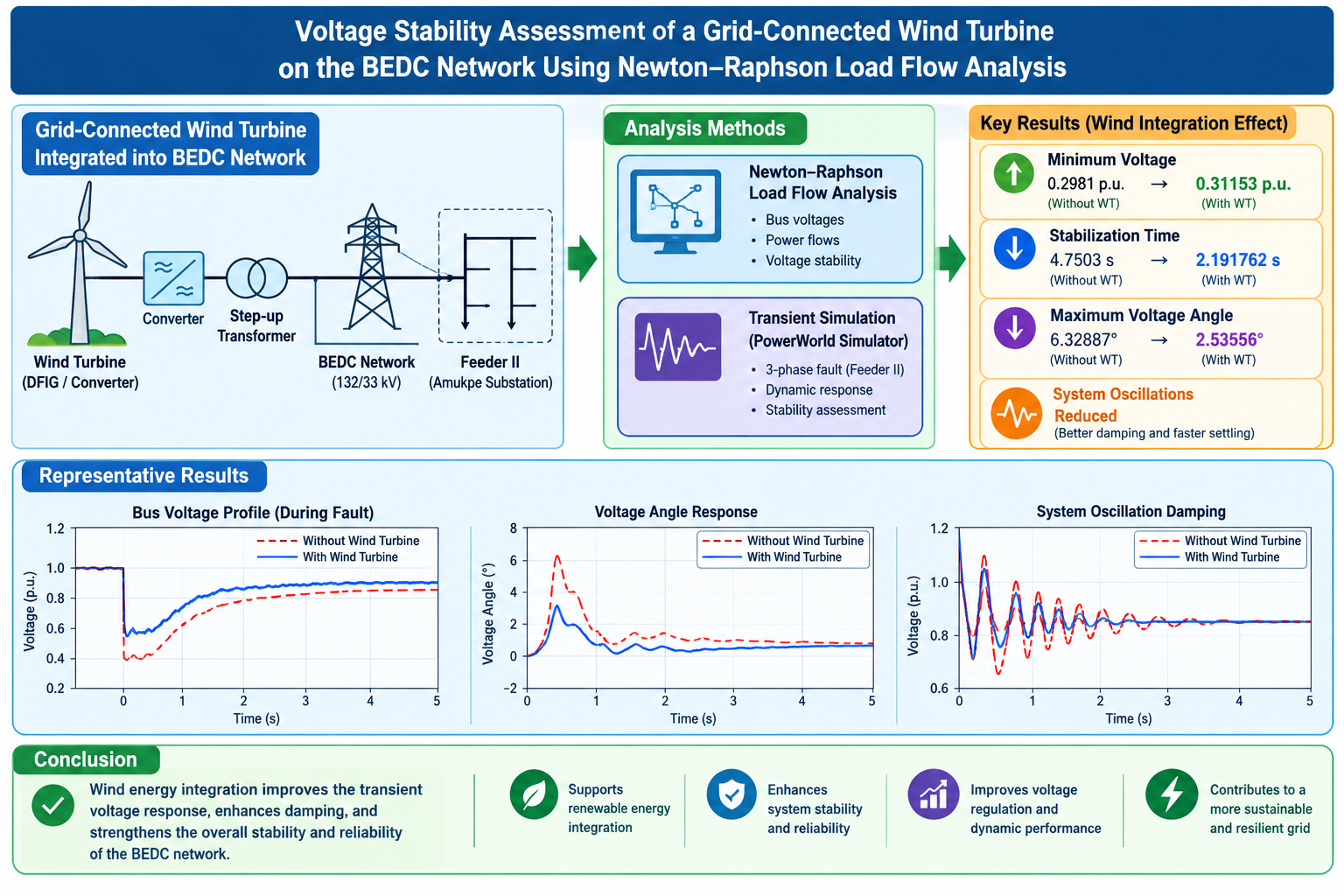
This study evaluates the voltage stability of a grid-connected wind turbine integrated into the Benin Electricity Distribution Company (BEDC) network using Newton–Raphson load flow and transient simulations in PowerWorld Simulator. The network was analyzed under steady-state and three-phase fault conditions before and after wind turbine integration. A three-phase fault was applied to Feeder II of the Amukpe 132/33 kV substation. Results showed improved voltage stability following wind turbine integration. The minimum voltage increased from 0.2981 p.u. to 0.31153 p.u., while stabilization time decreased from approximately 4.7503 s to 2.191762 s. In addition, the maximum voltage angle reduced from 6.32887° to 2.53556°, with fewer system oscillations observed. These findings indicate that wind energy integration can improve transient voltage response, enhance damping, and strengthen the overall stability and reliability of the BEDC network.