Beyond Best-Fit Curves: Revealing Hidden Reliability Patterns in Published West African Tractor Repair and Maintenance Datasets
Keywords:
Tractor Repair and Maintenance; Degradation Curve; Piecewise Regression; Weibull Hazard; Survival Analysis; Logistic Regression; NigeriaAbstract
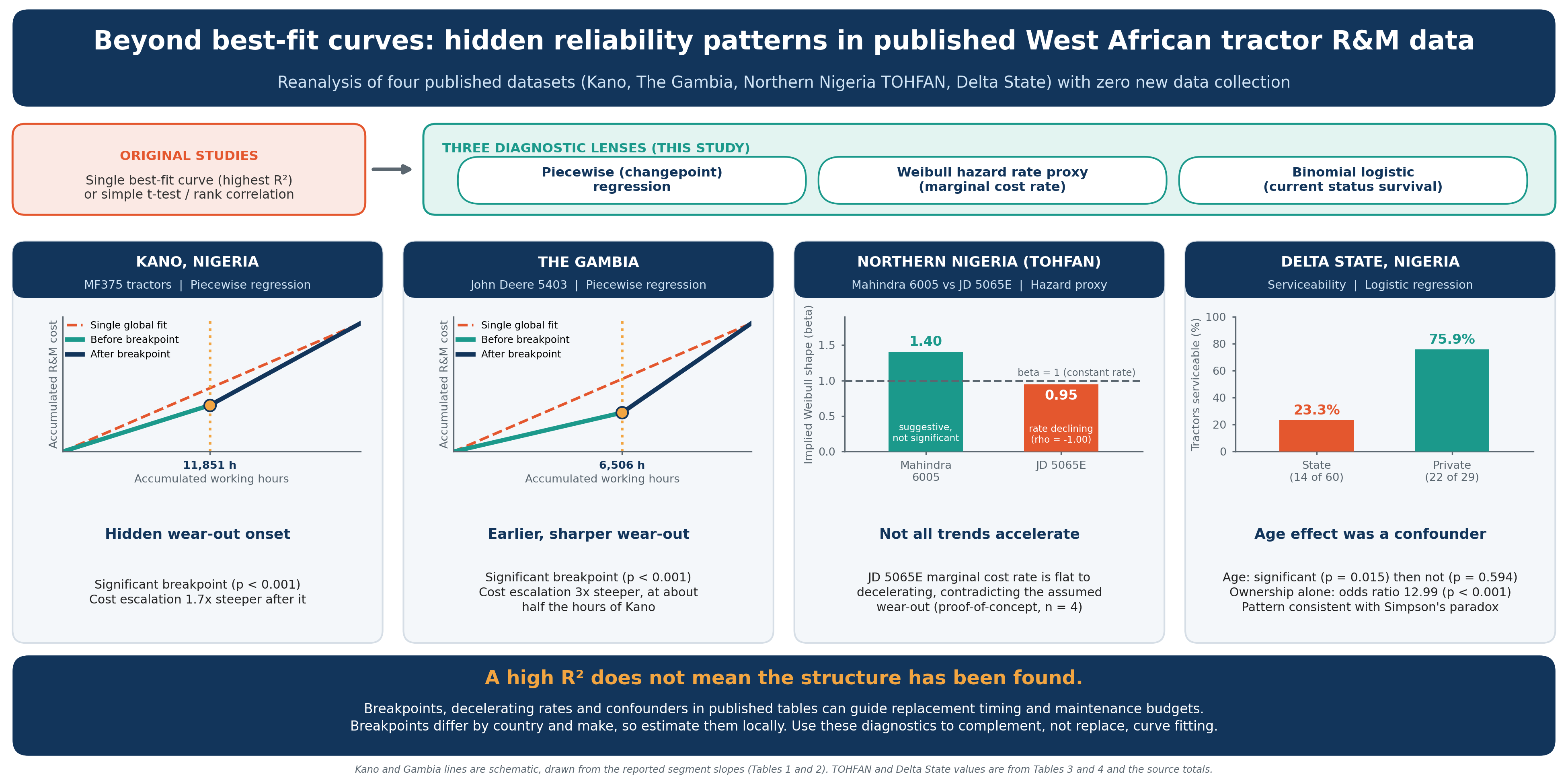
Four published West African studies on tractor repair-and-maintenance (R&M) performance, three from Nigeria (Kano; Northern Nigeria/TOHFAN; Delta State) and one from The Gambia, originally relied on best-fit curve selection from a small candidate menu, or on simple descriptive comparisons (t-test, rank correlation). This study reanalyzes the same published, grouped data tables using degradation-curve and survival-analysis methods that none of the four original studies applied: piecewise (change point) regression, Weibull-hazard-rate-proxy analysis, and binomial logistic (current-status survival) regression. The central methodological shift is from asking which single curve fits the data best overall to asking whether the data conceal a structural break, a decelerating rather than accelerating trend, or a confounding variable that a best-fit curve or a simple two-group comparison cannot, by construction, detect. Applying this shift to the four datasets reveals patterns invisible to the original analyses. Both the Kano and Gambia cost-accumulation trajectories show a statistically significant wear-out-onset breakpoint, occurring earlier and with a sharper post-breakpoint cost escalation in the Gambia dataset than in Kano, indicating that the phenomenon generalizes across country and tractor make while its precise timing does not. For the TOHFAN dataset, the marginal cost-escalation rate for one tractor brand is flat-to-decelerating rather than accelerating, directly contradicting the wear-out assumption implicit in the original curve choice, while the second brand shows only a suggestive, statistically underpowered acceleration signal that this study treats as an indicative proof-of-concept rather than a confirmed result. For the Delta State dataset, an apparent age-serviceability association reverses to non-significance once tractor ownership type is accounted for, with ownership alone emerging as the dominant predictor, a pattern consistent with Simpson's paradox that a supplementary, model-free check on the raw ownership totals also supports. Taken together, these reanalyses show that published aggregate R&M data can conceal policy-relevant structure that a single global curve fit is not designed to detect, and argue for methodological diversification, a complement to, not a replacement for, the region's existing curve-fitting tradition.