COMBINED RICE HUSK ASH–FLY ASH AS A SUPPLEMENTARY CEMENTITIOUS BINDER IN CONCRETE: INFLUENCE OF BLENDING RATIO ON WORKABILITY, COMPRESSIVE AND FLEXURAL STRENGTH DEVELOPMENT UP TO 90 DAYS
Keywords:
Rice husk ash; fly ash; blended concrete; compressive strength; flexural strength.Abstract
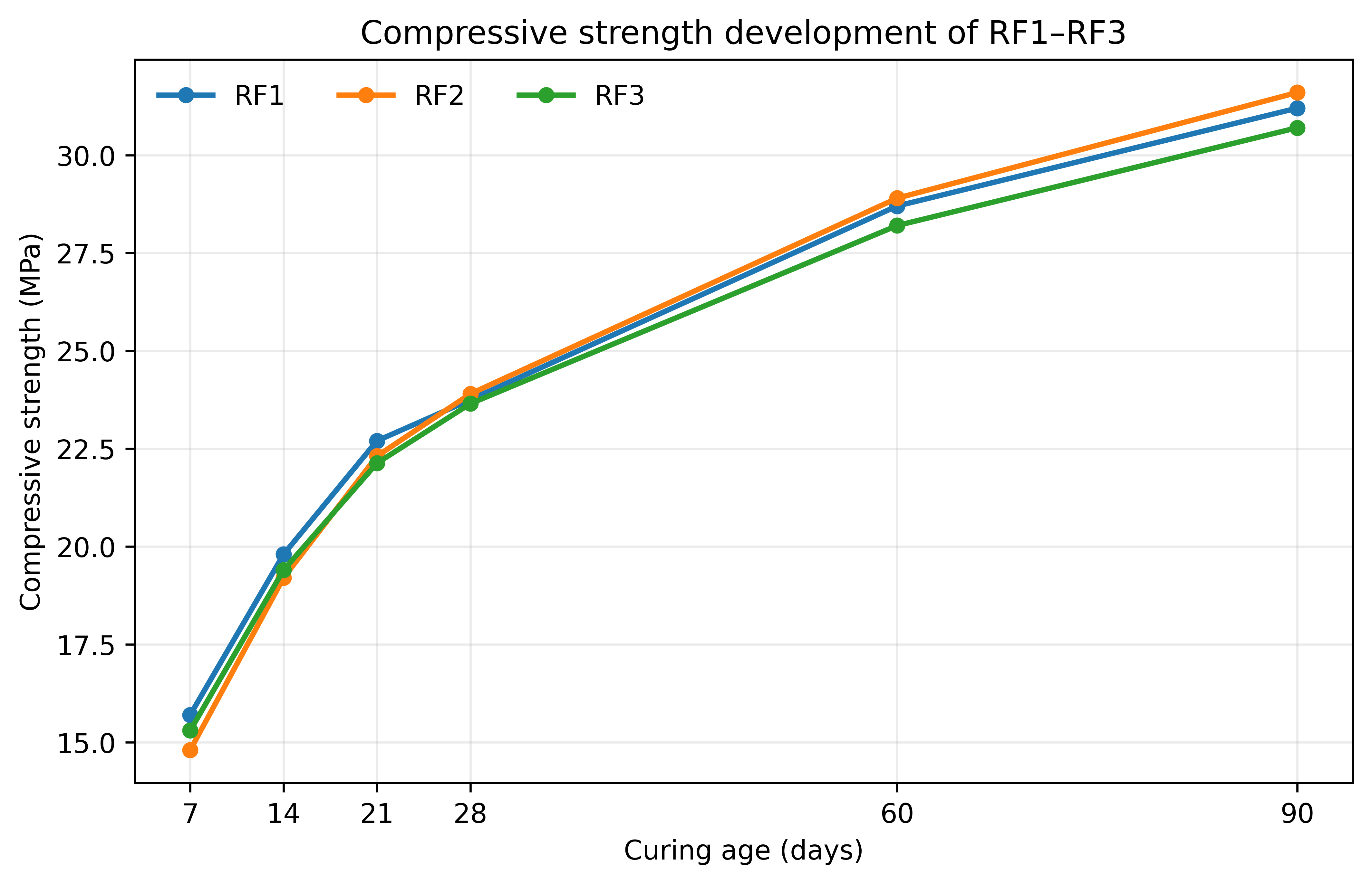
This study investigated the performance of concrete incorporating combined rice husk ash (RHA) and fly ash (FA) at different blending ratios. Three mixtures were prepared at a constant total cement replacement level of 10%: RF1 (5% RHA + 5% FA), RF2 (3.33% RHA + 6.67% FA), and RF3 (2.50% RHA + 7.50% FA), corresponding to RHA:FA blending ratios of 1:1, 1:2, and 1:3, respectively. A concrete mix ratio of 1:2:4 and a water-to-cementitious-material ratio of 0.57 were used. Workability, compressive strength, and flexural strength were evaluated at 7, 14, 21, 28, 60, and 90 days. X-ray fluorescence analysis showed that the SiO₂ contents of RHA and FA were 72.81% and 56.64%, respectively, while FA contained higher proportions of Al₂O₃ and Fe₂O₃. Slump increased from 136 mm for RF1 to 149 mm for RF3. Both compressive and flexural strengths increased with curing age. At 90 days, compressive strengths were 31.20, 31.60, and 30.70 MPa for RF1, RF2, and RF3, respectively, while flexural strengths were 3.47, 3.49, and 3.44 MPa. Two-way analysis of variance at a significance level of 0.05 indicated significant effects of mixture proportion, curing age, and their interaction on compressive strength (p = 0.0047, p < 0.001, and p = 0.0301, respectively). For flexural strength, curing age had a significant effect (p < 0.001), whereas the effects of mixture proportion (p = 0.474) and its interaction with curing age (p = 0.991) were not statistically significant. RF2 recorded the highest observed 90-day mean compressive and flexural strengths, although a statistically significant flexural-strength advantage over the other mixtures was not established. These findings provide a comparative assessment of the tested RHA–FA blending ratios and their influence on concrete workability and strength development under the experimental conditions investigated.