Traffic Signaling Control for a Three-Leg Busy Intersection in Nnewi Commercial Metropolis
Keywords:
Amber Time, Green Time, Optimum Cycle Length, Red Time, Signal Design, Traffic CountAbstract
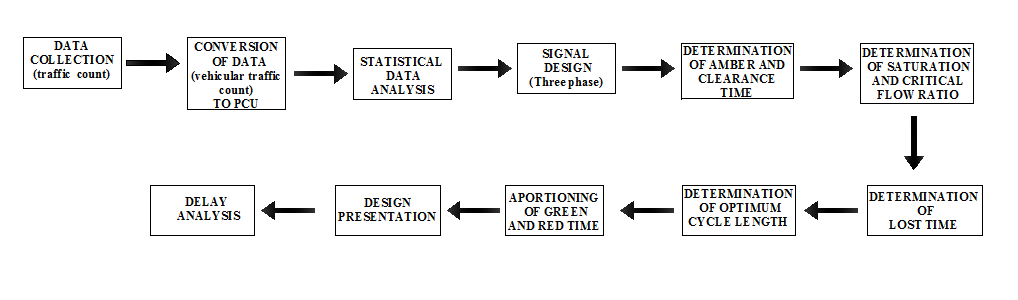
Transportation enables and enhances the movement of people, goods, and services from one location to another. It is an important aspect of human existence. As urban travel demand increases, traffic congestion has become a persistent challenge. This has brought about several attempts to improve the efficiency of movement through various traffic control mechanisms. This research focused on evaluating traffic flow characteristics and developing an appropriate traffic signal control scheme for the First Bank intersection at Nkwo Nnewi, Nnewi North Local Government Area of Anambra State Nigeria. The intersection has three legs. The widths of the approaches vary, measuring 8.4 m on the Northbound approach, 9.9 m on the Eastbound approach, and 11.25 m on the Westbound approach. Traffic volume studies was conducted to ascertain the peak hour traffic flow at the intersection. The traffic volumes were normalized based on the Passenger Car Unit (PCU) values. The traffic signal design was developed primarily based on Webster’s signal design method, while accounting for the geometric characteristics of the approaches to the junction. The signal design analysis produced an optimum cycle length of 43 seconds and a total effective green time of 28 seconds. Peak-hour delay prior to signalization was observed to be 92 seconds per vehicle. The delay which was estimated using the simplified Webster delay model was reduced to 26.33 seconds per vehicle, representing a 71.38% decrease in average delay. The proposed traffic signal design is therefore recommended for implementation at First Bank Junction and at similar congested intersections to improve traffic operations, reduce delays, and enhance intersection performance.