Thermodynamic and Economic Assessment of Pre- and Post-Pump Internal Heat Exchanger Integration in an Ammonia–Water Absorption Refrigeration Cycle
Keywords:
ammonia–water absorption refrigeration; internal heat exchanger; coefficient of performance; Aspen HYSYS; thermodynamic simulation; preliminary cost estimationAbstract
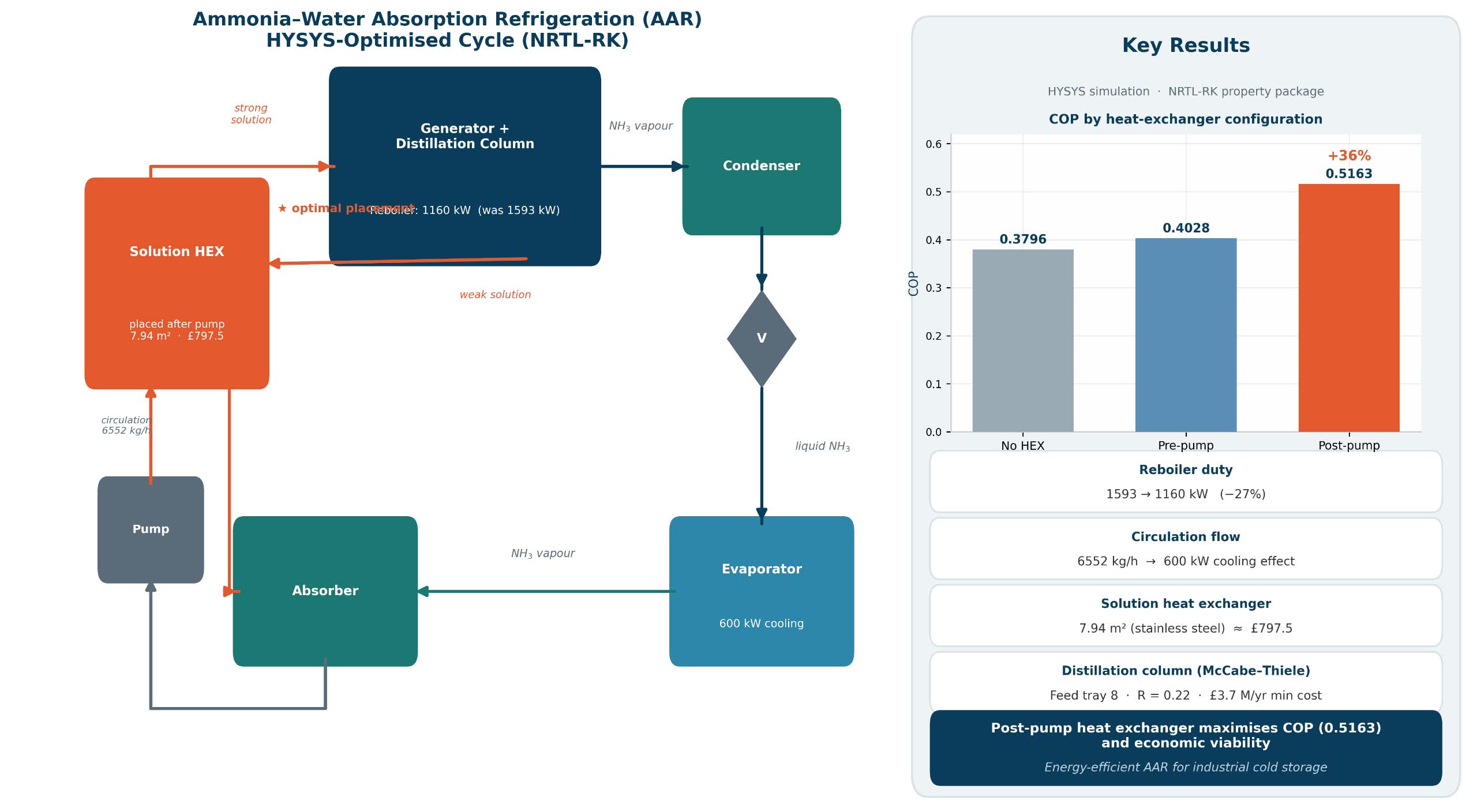
This study compares three steady-state simulations of an ammonia–water absorption refrigeration (AAR) cycle: a baseline without an internal heat exchanger (IHE), an IHE placed before the solution pump, and an IHE placed after the pump. The NRTL–Redlich–Kwong (NRTL–RK) property method was selected for the ammonia–water mixture. At a nominal cooling duty of 600 kW, the reported coefficient of performance (COP) values were 0.3762, 0.4028, and 0.5165 for the baseline, pre-pump, and post-pump configurations, respectively. Relative to the baseline, the pre-pump and post-pump arrangements increased COP by approximately 7.0% and 37.3%, respectively. The corresponding reported reboiler duties were 1593, 1488, and 1160 kW, indicating a 27.2% reduction for the post-pump configuration relative to the baseline. The reported circulation rate was 6552 kg h⁻¹. A preliminary area-based estimate gives an IHE area of approximately 7.98 m² and an indicative area cost of £797.50 under an assumed unit cost of £100 m⁻². Separately, the manuscript reports an annual distillation-column operating cost of £3.7 million; this figure cannot be reconciled with the available cost assumptions and is therefore treated as provisional rather than directly comparable with the exchanger estimate. The results support the post-pump arrangement thermodynamically within the stated simulation conditions, while further validation, consistent equipment costing, and sensitivity analysis are required before industrial economic feasibility can be established.