Submissions
Author Guidelines
GUIDE FOR AUTHORS
About the Journal
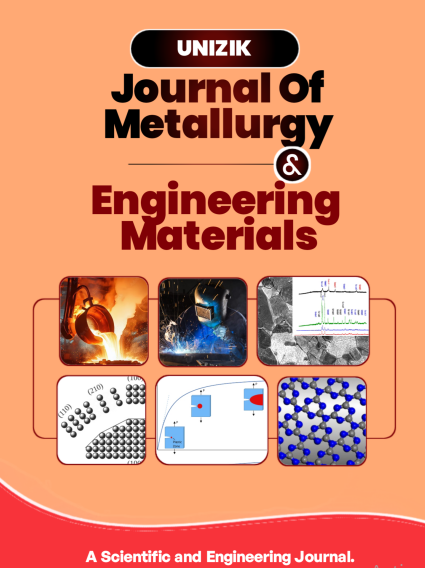
The UNIZIK Journal of Metallurgy and Engineering Materials (UJMEM) is an international, peer-reviewed, open-access journal open-access journal publication of the Department of Metallurgical and Materials Engineering, Nnamdi Azikiwe University, Awka, Nigeria.
UJMEM offers a global platform for the publication of original research, technical papers, and comprehensive reviews across all areas of metallurgy and materials science.
The journal aims to enhance the understanding of how processing, structure, and properties interact to influence the performance, durability, and reliability of engineering materials under diverse service conditions. UJMEM publishes contributions that offer new insights into the relationship between the synthesis, processing, and performance of materials, emphasizing the interplay between microstructure and properties. The journal targets research that investigates how factors such as the processing history, operating environment, and microstructural evolution affect the mechanical and chemical behavior of materials.
Aim and Scope
UJMEM publishes high-quality contributions in a broad range of materials science and engineering topics, with a specific focus on the following areas:
- Microstructure–property relationships in metallic and non-metallic systems
- Mechanical behavior, deformation, and fracture mechanics
- Thermal processing, solidification, and phase transformations
- Corrosion, oxidation, wear, and surface engineering
- Advanced and composite materials (metal, ceramic, and polymer-based)
- Additive manufacturing and welding metallurgy
- Minerals processing, extractive metallurgy, and sustainable metallurgy
- Environmental degradation, failure analysis, and reliability engineering
Excluded Topics
UJMEM does not consider topics focused on liquid alloys, purely organic materials and polymers, coordination chemistry, ionic liquids, catalysis (unless combined with detailed microstructural analysis), and biochemistry. Manuscripts that are purely computational without experimental validation, or that present only synthesis and characterization without the study of material properties or device performance, fall outside the journal's scope. Similarly, technical reports and purely theoretical studies without material application are not considered.
Article Types
The UNIZIK Journal of Metallurgy and Engineering Materials (UJMEM) welcomes the following types of contributions for publication:
1. Regular Papers
Regular papers present new, original research that has not been previously published. These papers may be theoretical, experimental, or practical in nature, provided they contribute significantly to the advancement of knowledge in the fields of metallurgy and materials science. Each submission must make a clear contribution to the scientific record.
Peer Review Process
UJMEM follows a single-anonymized peer review process, ensuring that reviewers remain anonymous to authors. Submitted manuscripts are first assessed by the journal’s editors to determine their suitability for publication. If deemed appropriate, the manuscript will be sent to at least one independent expert reviewer for a detailed assessment of its scientific quality.
Editorial Decision
The final decision to accept or reject a submission is made by the journal’s editorial team, based on the reviewers’ assessments. Authors wishing to appeal a decision may submit a formal appeal in accordance with the journal’s appeal process. Only one appeal per submission is allowed, and the appeal decision is considered final.
Editors are not involved in making decisions about manuscripts they have authored, those written by family members or close colleagues, or those that pertain to products or services in which they hold a financial interest. In such cases, the standard editorial and peer review process will be followed, with the manuscript being handled independently from the editor involved and their research group.
Submission Declaration
Manuscript Submission
Authors are invited to submit original, unpublished manuscripts through email submission:
All submissions will undergo double-blind peer review by experts in the field.
Author guidelines are available on the journal’s webpage
(https://journals.unizik.edu.ng/ujmem/about).
When authors submit an article to the UNIZIK Journal of Metallurgy and Engineering Materials (UJMEM), it is implied that:
- The work described has not been published previously, except in the form of a preprint, abstract, published lecture, academic thesis, or registered report. Authors should adhere to the journal's policy on multiple, redundant, or concurrent publication.
- The article is not under consideration for publication in any other journal.
- The publication of the article is approved by all authors and, where necessary, by the responsible authorities of the institution or organization where the work was conducted.
- If accepted, the article will not be published elsewhere in the same form, in English or any other language, including electronically, without the written consent of the copyright holder.
Authorship
All authors listed on a submission must have made significant contributions to the following areas:
- The conception and design of the study, or the acquisition, analysis, or interpretation of data.
- Drafting the manuscript or critically revising it for intellectual content.
- Providing final approval of the version to be submitted for publication.
All authors should agree to be accountable for all aspects of the work, ensuring that any questions regarding the accuracy or integrity of the research are appropriately addressed and resolved.
Changes to Authorship
UJMEM strongly advises that the authorship list and order of authors are finalized before the initial submission. The journal's policy on authorship changes is as follows:
- All authors must be listed in the manuscript, and their details entered into the submission system at the time of submission.
- Any additions, deletions, or rearrangements of author names must occur prior to the manuscript's acceptance and can only be made with the approval of the journal editor.
Requests to change the authorship should be initiated by the corresponding author and must be accompanied by a clear explanation of the reason for the change. Written confirmation must be provided by all authors, including those being added or removed, to confirm their agreement with the proposed change.
In exceptional circumstances, the journal editor may consider changes to authorship post-acceptance. If a change request is approved after the manuscript has been published, it will result in the issuance of a corrigendum.
Publication of the manuscript may be paused while the authorship change request is under consideration. Any unauthorized changes to authorship may result in rejection of the manuscript or, if already published, retraction of the article.
Declaration of Interests
All authors submitting to the UNIZIK Journal of Metallurgy and Engineering Materials (UJMEM) must disclose any financial, professional, or personal relationships with other individuals or organizations that could inappropriately influence or bias their work. Examples of potential competing interests include:
- Employment
- Consultancy work
- Stock ownership or options
- Honoraria
- Paid expert testimony
- Patent applications or registrations
- Grants or other forms of financial support
Authors are required to complete the Declaration of Interests form during submission. If there are no competing interests to declare, authors should select the option stating "I have nothing to declare." The completed declaration should be uploaded during the "attach/upload files" step of the submission process as a Word document in .doc or .docx format. Author signatures are not required.
Funding Sources
Authors must disclose all funding sources that provided financial support for conducting the research and/or preparing the article. The role of the funders, if applicable, should be explicitly stated in relation to study design, data collection, analysis, interpretation, writing of the manuscript, and the decision to submit for publication. If the funding body had no involvement in these aspects, this must also be stated in the manuscript.
Authors should list their funding sources in a standard format, as demonstrated below:
Example: Funding: This work was supported by the National Institutes of Health [grant numbers xxxx, yyyy]; the Bill & Melinda Gates Foundation, Seattle, WA [grant number zzzz]; and the United States Institutes of Peace [grant number aaaa].
If no external funding has been received for the research, authors are encouraged to include the following sentence:
This research did not receive any specific grant from funding agencies in the public, commercial, or not-for-profit sectors.
Declaration of Generative AI in Scientific Writing
Authors must disclose any use of generative AI and AI-assisted technologies in the preparation of the manuscript. The following policy applies solely to the writing process and does not cover the use of AI for data analysis or other research purposes:
- Generative AI tools may only be used to improve readability and language, and should always be applied with human oversight and control.
- Authors must carefully review and edit any content produced by AI, as such tools can generate authoritative-sounding content that may be inaccurate, incomplete, or biased. The responsibility for the final content lies entirely with the authors.
- Generative AI tools cannot be listed or credited as authors, as authorship implies responsibilities that can only be attributed to humans.
If AI tools were used, authors must add a statement at the end of the manuscript under a section titled "Declaration of Generative AI and AI-Assisted Technologies in the Writing Process." An example of such a statement is:
During the preparation of this work, the author(s) used [NAME OF TOOL/SERVICE] to [REASON]. The authors reviewed and edited the content accordingly and take full responsibility for the final content of the manuscript.
Basic tools used to check grammar, spelling, and references do not need to be disclosed. If no AI tools were used, this section does not need to be included.
Please note that UJMEM prohibits the use of generative AI tools, such as ChatGPT, by reviewers or editors during the peer review and manuscript evaluation process. The journal may update its policy in the future as compliant AI tools become available.
Use of Inclusive Language
UJMEM requires the use of inclusive language that acknowledges diversity, promotes respect, and eliminates bias. Authors must avoid language that might imply superiority or inferiority based on:
- Age
- Gender
- Race
- Ethnicity
- Culture
- Sexual orientation
- Disability or health condition
Authors are encouraged to use plural nouns and gender-neutral language where possible. Avoid assumptions about the beliefs or backgrounds of readers, and ensure that writing is free from stereotypes, cultural assumptions, and biased terminology. These guidelines are not exhaustive but serve as a reference to help authors use respectful and inclusive language throughout their submissions.
To prepare your manuscript in compliance with the journal's guidelines, please follow these instructions closely:
Title Page
1. Article Title: Ensure the title is concise, informative, and avoids abbreviations or formulae where possible.
2. Author Names: Include the full names of all authors, with the order matching the submission system. If needed, you may add your name in your own script in parentheses after the English version.
3. Affiliations: Provide the full affiliation addresses (including the institution, city, country, and email address) below each author’s name. Use lowercase superscripts to indicate affiliations.
4. Corresponding Author: Clearly mark the author responsible for all correspondence during the review and publication process. Provide an up-to-date email address.
5. Present Address (if applicable): If any author has moved, indicate their current address in a footnote while keeping their primary affiliation intact.
Abstract (up to 250 words)
- Provide a concise summary of the research purpose, main results, and conclusions.
- Avoid citations and non-standard abbreviations.
- Ensure the abstract can stand alone without reference to the full text.
Keywords (5-7 terms)
- Include 5-7 keywords to enhance discoverability of your article.
- Use established terms and avoid multi-word phrases unless necessary.
Highlights (Optional but Encouraged)
- Submit as a separate file.
- Provide 3-5 bullet points, each up to 85 characters.
- Focus on the novel results and methodologies of your study.
Main Text
- Structure: Organize the manuscript into sections such as:
- Introduction
- Methods
- Results
- Discussion
- Conclusion
- Formatting:
- Use double spacing throughout.
- Use 10-point Times New Roman font.
- Ensure page numbers begin on the title page.
- Mathematics and Units:
- Use the SI system for units.
- Present variables in italics and vectors in boldface italics.
- Number all equations consecutively (e.g., Eq. (1)).
- For fractions, use the solidus (e.g., X/Y).
Tables
- Number tables consecutively using Roman numerals (e.g., Table I, II).
- Place each table near its first citation in the text.
- Ensure tables are submitted in an editable format (not as images) and use minimal horizontal lines.
- Include captions and any relevant notes directly below the tables.
Figures and Artwork
1. Format:
- Submit figures in separate high-resolution TIFF, JPEG, or PNG files.
- Minimum resolutions:
- 1000 dpi for line drawings
- 300 dpi for color/grayscale images
- Ensure all figures are numbered consecutively (Figure 1, 2, etc.).
2. Captions: Provide captions in a separate file, briefly describing each figure without embedding text on the figure itself.
3. Color: Indicate whether the figures should appear in color online only or in both print and online.
Acknowledgments
- Include a separate section before the references to acknowledge assistance and funding sources.
- Write funding agency names in full.
Conflict of Interest
- Declare any financial or commercial conflicts of interest. If there are none, state: "The authors declare no conflicts of interest."
Funding Sources
- List all funding sources as follows:
- "This work was supported by [funder name, grant number]."
- If no specific funding was received: "This research did not receive any specific grant from funding agencies in the public, commercial, or not-for-profit sectors."
Appendices
- Label appendices as A, B, etc.
- Number equations, figures, and tables in appendices separately (e.g., Eq. (A.1), Table A.1).
References
- Use Vancouver style numbering.
- Number citations sequentially in the text using brackets (e.g., [1]).
- Include DOIs where available.
- Example reference formats:
- Journal article: [1] Author(s), Title, Journal, Year; Volume, numbers.
- Book: [2] Author(s), Title, Edition, Publisher, Year.
- Chapter in book: [3] Author(s), Title, In: Editor(s), Book Title, Publisher, Year, Pages.
By following these instructions, your manuscript will be properly formatted for submission.
Submission Preparation Checklist
All submissions must meet the following requirements.
- The submission has not been previously published, nor is it before another journal for consideration (or an explanation has been provided in Comments to the Editor).
- The submission file is in OpenOffice, Microsoft Word, or RTF document file format.
- Where available, URLs for the references have been provided.
- The text is single-spaced; uses a 12-point font; employs italics, rather than underlining (except with URL addresses); and all illustrations, figures, and tables are placed within the text at the appropriate points, rather than at the end.
- The text adheres to the stylistic and bibliographic requirements outlined in the Author Guidelines.
Articles
Section default policy
Privacy Statement
The names and email addresses entered in this journal site will be used exclusively for the stated purposes of this journal and will not be made available for any other purpose or to any other party.
